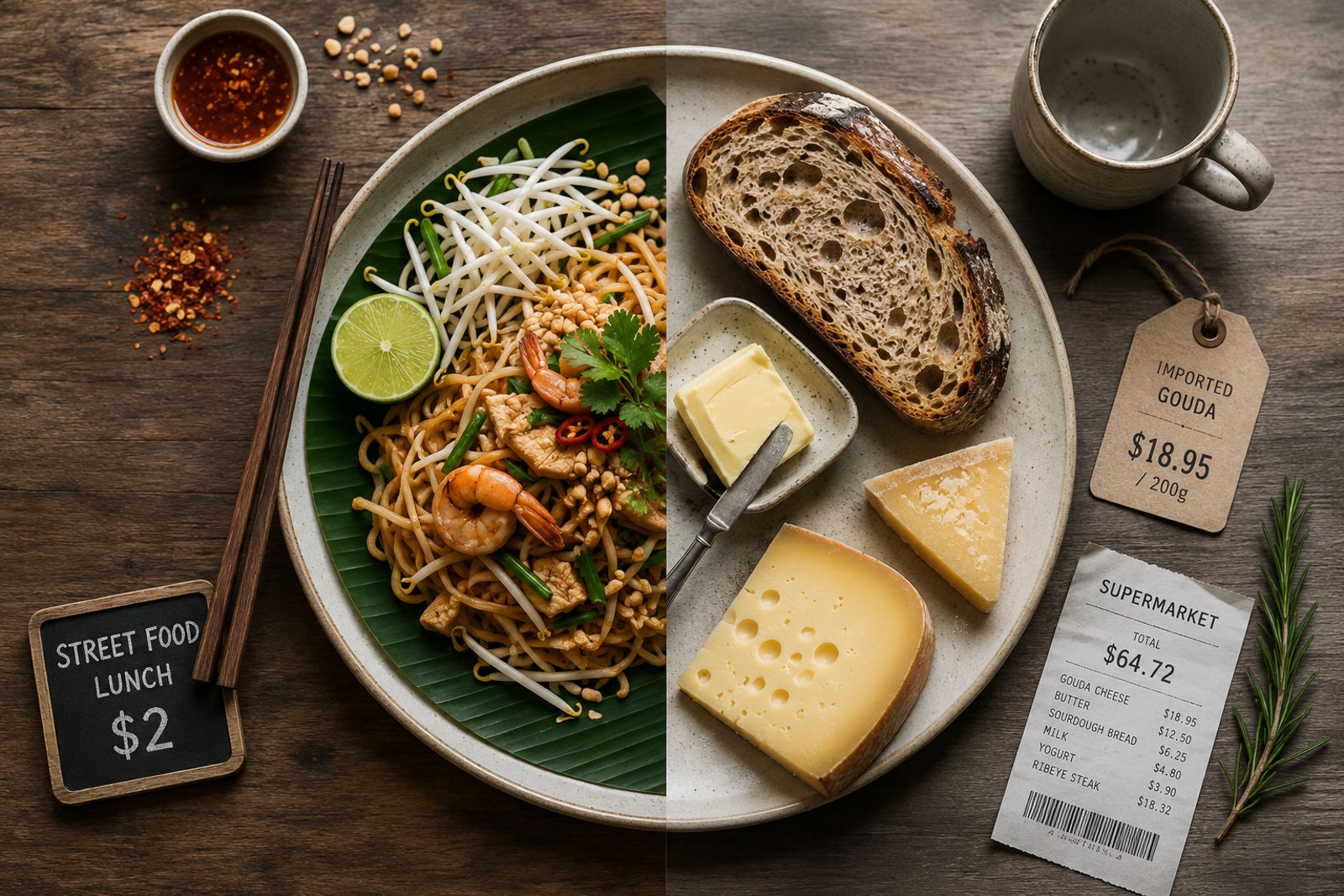
If you spend enough time around global transition forums, you will eventually encounter the math. It is always presented with the serene confidence of a freshly minted convert: Two-dollar bowls of street noodles in Asia. A three-dollar plate of rice and beans in Central America. A seamless, sun-drenched lifestyle unlocked for less than the cost of a modest suburban mortgage back home.
- The Holiday Trap and the Psychology of Routine
- The Family Factor: Children and Culinary Friction
- Regional Blind Spots: Agricultural Myths and Genetic Tariffs
- The Health-Shock: When the Body Rejects the Routine
- Seasonal Volatility and Island Realities
- The Mediocrity Tax in Expat Enclaves
- The DIY Trap: The Hidden Logistics of Self-Reliance
- The Social and Emotional Currency of Food
- The Evolving Equation: Rethinking the Cost of Living
Crowd-sourced relocation databases and cost-of-living algorithms have institutionalized this arithmetic, reducing the dizzying complexity of living overseas to a neat ledger of espresso shots, taxi fares, and local entrees. On paper, the thesis is airtight. You pack your bags, trade grey winters for tropical sea breezes, and congratulate yourself on outsmarting the system.
In practice, however, this financial spreadsheet usually collides headfirst with human biology, psychology, logistics, regional agricultural realities, and family dynamics.
What these data models routinely omit is a phenomenon well-understood by relocation veterans, yet oddly absent from the glossy literature of expatriation: the quiet, inevitable onset of Food Fatigue. It is the moment the initial novelty of foreign seasonings, exotic produce, and hyper-local street food curdles into sensory exhaustion. And when it strikes, your neatly calculated cost-of-living index collapses like a soufflé in a drafty kitchen.
The Holiday Trap and the Psychology of Routine
Most people plan their relocations while on vacation, which is precisely where the financial miscalculation begins.
During a two-week holiday, dining is an event. You wake up to a hotel breakfast buffet, spend your evenings in atmospheric bistros, sip cocktails at beach bars, and graze at colorful night markets. It is exciting, sensory, and inherently temporary.
Fast forward three years. It is a rainy Monday evening. You are exhausted from work, dealing with local bureaucracy, or managing household logistics. You do not want an adventure; you do not want another plate of hyper-spiced street food or starch-heavy local staples cooked in low-grade oils. You simply want mashed potatoes, a clean piece of roast chicken that tastes like home, or a simple slice of sourdough with familiar butter.
Many expatriates report that after the initial honeymoon phase—often several weeks or months—the excitement begins to give way to routine. The brain reaches a saturation point. The constant onslaught of intense, unfamiliar flavor profiles begins to register not as a discovery, but as an exertion. The body demands Comfort Food: the precise fat, salt, protein, and texture profiles of its upbringing.
For some, this fatigue arrives early. For long-term expatriates, it can be a slow-burning fuse that takes years to detonate. During the first few years, pride and the sheer momentum of integration keep you anchor-bound to local habits. But eventually—at year three, five, or ten—the “expat bonus” wears off. Living abroad ceases to be an extended holiday and settles into mundane daily life.
When you attempt to suppress this biological and psychological urge, you inevitably end up paying twice: emotionally and financially.
The Family Factor: Children and Culinary Friction
While solo travelers and couples can theoretically force themselves to adapt to local diets through sheer willpower, families encounter an entirely different reality. Children change everything.
Parents quickly discover that children are often far less adventurous than adults when it comes to palate adaptation. The excitement of local street cuisine that fascinates newcomers may simply translate into skipped meals, nutritional anxieties, and expensive emergency trips to international supermarkets.
Suddenly, imported breakfast cereals, familiar school-lunch ingredients, recognizable snacks, and child-friendly dairy items become recurring, non-negotiable budget items rather than occasional indulgences. A family’s monthly grocery expenditure rarely scales linearly; in foreign environments, it often explodes exponentially simply to maintain domestic harmony at the dinner table.
Regional Blind Spots: Agricultural Myths and Genetic Tariffs
When you finally surrender to Food Fatigue and wander into a local supermarket hoping to recreate a piece of home, you collide with stark agricultural and cultural realities that vary dramatically by geography.
In many developing regions, supply chains are hyper-optimized for local staples, creating massive blind spots for western expats:
- The Dairy Void in Asia: In many parts of Southeast and East Asia, lactose intolerance is common among adults, and dairy was historically never part of the agricultural landscape. Finding basic fermented protein like cottage cheese, Greek yogurt, or real Gouda means paying exorbitant cold-chain import fees—effectively a biological tax built into your weekly grocery run.
- The “Beef Fallacy” & South America: Prospective expats moving to South America—countries like Argentina, Uruguay, or Southern Brazil—rightly expect world-class, affordable grass-fed beef. But the trade-off hits elsewhere. Try sourcing decent Asian pantry staples, genuine European rye bread, or affordable imported olive oil in Buenos Aires or Medellín, and you will quickly encounter severe import restrictions, high tariffs, or sheer unavailability.
- Central America & The Caribbean Import Wall: Destinations like Costa Rica, Panama, or Caribbean island states appear affordable on paper if you stick to casados (rice, beans, and plantains). However, their supermarkets are dominated by imported North American goods priced at double or triple their US retail value. A routine trip to a store like Auto Mercado in Costa Rica for familiar brand-name groceries can rival the prices of a high-end supermarket in Manhattan.
Even basic daily staples present subtle quality shocks everywhere. Commercial bread across many tropical markets is either laden with High Fructose Corn Syrup or impossibly sweet, while local butter often lacks the fat content required for European-style cooking or baking. Available cuts, processing methods, or product consistency differ substantially from what newcomers grew up with. It is not necessarily better or worse—simply fundamentally different from what your body considers baseline.
The Health-Shock: When the Body Rejects the Routine
Yet, the most dangerous blind spot in any budget-expat fantasy is not a craving for steak—it is the sudden onset of illness.
Whether it is a severe bout of regional gastroenteritis, the quiet metabolic shifts that come with aging, or a devastating medical diagnosis requiring harsh treatments like chemotherapy, health crises rewrite the rules of survival overnight. When your digestive system is compromised, street food and heavy local fare are no longer options. Heavily fried, overly spiced, or MSG-laden dishes become active enemies.
In that critical moment, the budget-expat framework completely disintegrates. The body urgently demands mild, unadulterated, highly digestible nourishment: clean broths, gentle steamed proteins, organic produce, and familiar, soothing grains.
In many developing destinations, clean, low-sodium, organic food is not the baseline—it is a luxury niche reserved for the ultra-wealthy. When you are ill, you lack both the physical immunity for street stalls and the stamina for culinary experiments. Your monthly food expenditure quadruples at the exact moment your personal resilience is at its lowest.
Seasonal Volatility and Island Realities
Relocation calculators also fail to capture market instability and extreme seasonal shifts.
In many popular expatriate havens—particularly island nations, tropical coastal zones, or mountain enclaves—food prices and availability fluctuate wildly. Unseasonal rains can destroy a region’s berry or tomato crop overnight, sending prices soaring 300%. Imported dairy or fresh produce arriving on container ships is subject to port delays, weather disruptions, and sudden tariff adjustments. You may find your favorite brand of butter or olive oil readily available for a month, only for it to disappear from store shelves entirely for the next six weeks.
This erratic supply chain forces expats into unpredictable spending patterns—buying in bulk when specialty items appear, or paying astronomical premiums for alternative imports when primary options run dry.
The Mediocrity Tax in Expat Enclaves
Desperate for relief, many turn to the restaurant scenes of local tourist hubs. What awaits them in the dining districts of Bali, Phuket, Tulum, or the Riviera Maya, however, is a different kind of tragedy: the homogenization of western dining.
The streetscapes of these enclaves are dominated by a predictable playbook: smash-burger joints, wood-fired pizzerias, and sun-bleached, health-obsessed açai bowl cafes. Because authentic western baseline ingredients—real butter, cold-pressed olive oil, un-processed meats, genuine mozzarella—are prohibitively expensive to import, operators compromise.
You end up paying Manhattan or London prices for a middle-tier pasta dish prepared with palm-oil substitutes and rubbery, imitation cheese. You are not merely paying a premium; you are paying a steep mediocrity tax for profound culinary disappointment.
Furthermore, moving away from global metropolitan hubs like London, New York, or Berlin means sacrificing true “multi-gastro” infrastructure. In those global cities, authentic Ethiopian, Vietnamese, Italian, and Mexican food exist side-by-side at world-class standards. In secondary expat havens, diversity is routinely replaced by twenty iterations of the exact same mediocre burger.
The DIY Trap: The Hidden Logistics of Self-Reliance
The inevitable counterargument from die-hard nomads is always: “Simply adapt. Cook at home from scratch. Bake your own bread, make your own cheese.”
Yet, the do-it-yourself ethos in a foreign land rapidly devolves into a subtle form of domestic servitude. The expat who sets out to ferment their own dairy, cultivate sourdough starter in tropical humidity, and hunt down elusive specialty ingredients across three different city districts quickly discovers that “living simply” has become a second full-time job.
Consider the logistical fragmentation that online relocation calculators completely ignore. At home, food shopping is a consolidated, single-stop routine. Abroad, sourcing a balanced weekly pantry often turns into a sprawling urban safari:
- Specialty meat from an import butcher
- Bread from an artisanal expat bakery
- Cheese from a high-end gourmet market
- Vegetables from an early-morning local market
- Wine from a licensed specialty store
When you factor in fuel, parking, ride-share fares, delivery fees, and hours spent navigating traffic across town, the hidden friction cost of simply stocking a fridge becomes immense.
To compound the issue, long-term rental properties in popular expat destinations are rarely designed for heavy culinary self-reliance. You are frequently confronted with mini-fridges that hold three days’ worth of food, a lack of built-in ovens, no dishwasher, and tiny counter spaces. Cooking complex, familiar meals from scratch in a kitchenette designed for reheating takeout rapidly converts a romantic lifestyle choice into daily frustration.
Time IS money—and spending four hours on a Tuesday tracking down decent cheddar is an expensive way to live.
The Social and Emotional Currency of Food
Beyond calories, budgets, and logistics lies the intangible emotional weight of dining.
Food is rarely just nutrition. It is memory, celebration, routine, and belonging. When familiar ingredients disappear, many expatriates discover that what they truly miss is not the product itself, but the emotional rituals attached to it—Sunday breakfasts with family, cherished holiday recipes, seasonal traditions, or the smell of fresh bread on a crisp morning.
When you lose access to these culinary anchors, a subtle form of cultural isolation sets in. You realize that food is one of the deepest tethering lines to your identity, and cutting it completely creates an emotional void that no amount of cheap tropical sunshine can fully fill.
The Evolving Equation: Rethinking the Cost of Living
When you aggregate the regional trade barriers, the mediocrity tax of local western dining, the necessity of imported comfort foods during illness, the demands of raising children abroad, and the sheer logistical effort of sourcing quality ingredients, the central illusion of crowd-sourced relocation sites completely evaporates.
For many people, the long-term equation becomes surprisingly balanced. The categories change, the trade-offs shift, and individual priorities evolve—but the idea that life abroad is permanently and dramatically cheaper often proves far less durable than relocation calculators suggest.
What you save on rent, domestic help, or local transport, you will inevitably reallocate toward imported butter, decent cuts of meat, private healthcare, specialty groceries, schooling, and flight tickets back home to taste the real thing.
If you are drafting a realistic budget for a life overseas, discard the two-dollar street-food metric. Build your projections on what we might call the 70/30 Rule: assume that seventy percent of your diet will harmonize with the local landscape and native ingredients, but ensure your financial runway can effortlessly absorb the thirty percent required for imported sanity and family comfort.
Moving abroad offers extraordinary cultural richness, personal growth, and fresh perspective. But if you are doing it purely to outsmart the cost of living, be prepared for the ultimate reality check: sooner or later, your palate will demand its heritage, and the price of feeling truly at home will always find a way to balance the books.