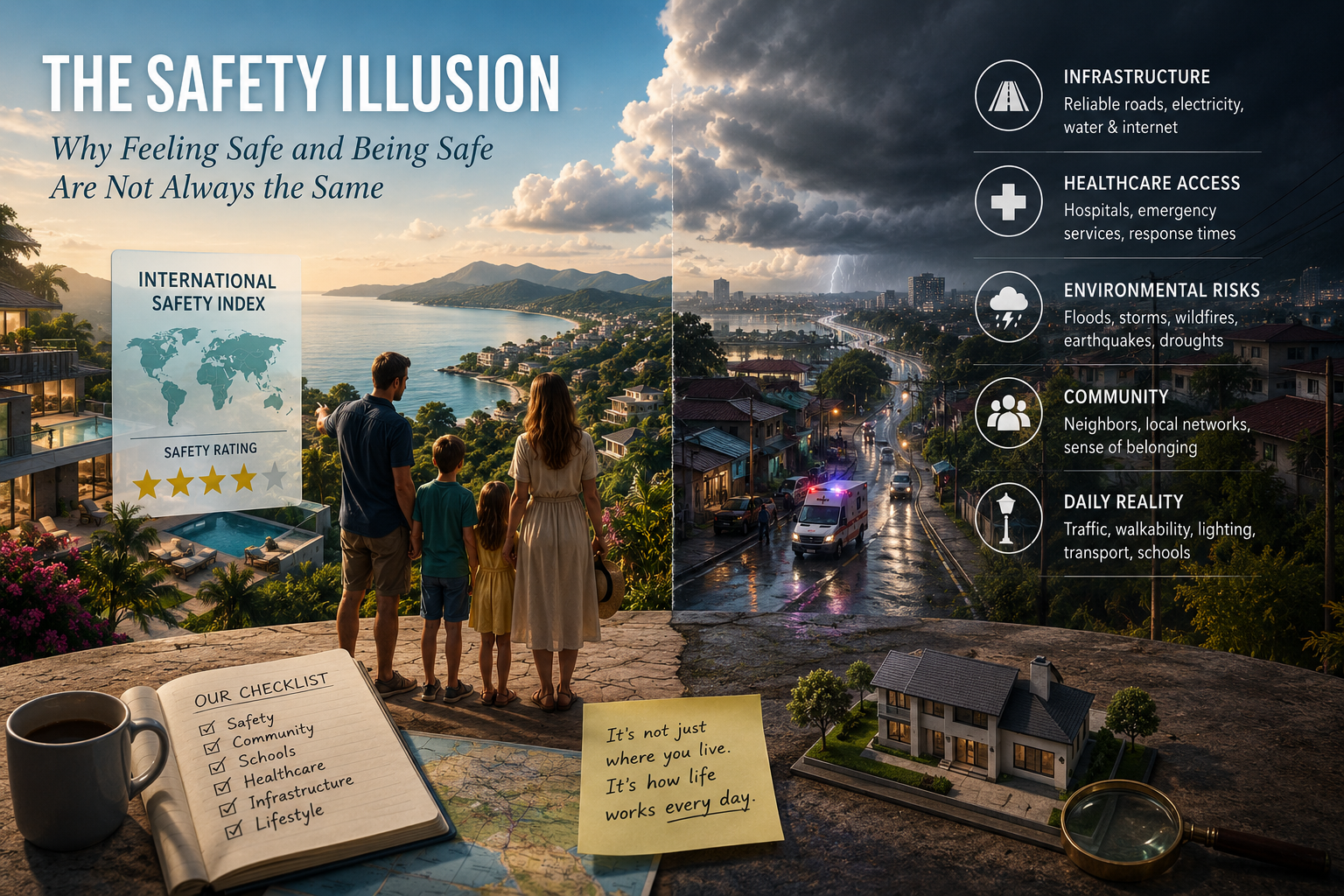
For anyone dreaming of a life abroad, safety is usually at the top of the checklist. Is the country safe? How high is the crime rate? Would I feel comfortable raising children or retiring there?
These are perfectly reasonable questions. Yet, the answers we find in international rankings and glossy expat brochures are often surprisingly incomplete.
Safety is frequently reduced to a single statistic, a colorful map index, or a sensationalized headline. Destinations are labeled as “safe” or “unsafe” as if everyday life could be measured by a single metric. But anyone who has actually relocated permanently, bought a second home, or built a life in a new country quickly learns a deeper truth: safety is nuanced. The place that looks pristine on paper may not offer the genuine security you need when real life happens.
Beyond Crime Statistics
Crime numbers dominate relocation guides, but they only tell a fraction of the story. A pristine neighborhood with statistically low crime can still feel incredibly isolating or even hazardous if the infrastructure is crumbling.
For daily peace of mind, safety begins long before you lock your front door. It’s in the answers to the practical, unglamorous questions:
- How chaotic or poorly lit are the surrounding roads?
- Can children walk or cycle without genuine danger from traffic?
- If someone has a medical emergency, how quickly can an ambulance actually reach the property?
- Are reliable hospitals hours away or just around the corner?
A destination that appears vibrant or a bit chaotic at first glance often benefits from strong local communities and a daily rhythm that creates an unexpected, deeply woven sense of security. These factors influence your quality of life far more than a national crime index ever could.
The Environmental Blindspot
Many relocation decisions focus so heavily on personal security that they completely overlook nature. Yet, environmental risks shape everyday life just as much as social ones. Flood zones, wildfire exposure, seasonal storms, earthquakes, or prolonged droughts don’t care about low crime rates.
What surprises many buyers is how much these risks vary—even within the same region. Two coastal properties separated by only a few kilometers can face completely different realities when a storm hits. Responsible property owners are looking beyond the beautiful sea views and asking the hard questions: How good is the local drainage? What are the actual building standards? Is the property insurable in the long term, and how climate-resilient is the area?
Infrastructure Creates Confidence
The strongest contributor to everyday safety is often completely invisible until it fails: reliable infrastructure.
Consistent electricity, clean running water, well-maintained roads, stable internet, and responsive emergency services rarely make it into tourism rankings. Yet, they quietly dictate your stress levels. A modest home backed by resilient public utilities almost always provides a greater sense of security than a luxury villa stranded in an area where essential services are unpredictable.
True confidence doesn’t come from assuming nothing will ever go wrong; it comes from knowing that when something does happen, the systems around you will work.
Communities Matter More Than Walls
Walk through many modern developments today, and you’ll see an emphasis on high walls, gated entrances, security guards, and surveillance cameras. While these measures have their place, they are only a cosmetic layer of safety.
A neighborhood’s culture matters just as much, if not more. Communities where residents actually know one another, where local shop owners recognize familiar faces, and where neighbors naturally look out for each other offer a level of protection that technology simply cannot replicate. For newcomers, integrating into the local community isn’t just about being friendly—it’s an investment in your own safety. True security, after all, is rooted in belonging.
Looking Beyond the Facade
When scouting a new home abroad, luxury should never be confused with resilience. An impressive waterfront residence can still sit dead center in a flood plain. A sleek new apartment tower might offer exceptional amenities while relying on aging, fragile municipal grids just beyond its gates.
Conversely, a more modest residential area might benefit from brilliant urban planning, excellent public services, and a remarkably stable local environment. Experienced buyers look through a broader lens. Instead of just asking, “Is this country safe?” they ask, “How does daily life actually function here on a rainy Tuesday?”
Making Better Decisions
People move abroad for a multitude of beautiful reasons: a better lifestyle, new horizons, financial freedom, or a slower pace of life. Safety belongs in that equation, but it deserves to be redefined.
Real safety cannot be bought with a gated entry or measured by a global ranking. It is found in resilient infrastructure, thoughtful urban planning, accessible healthcare, and communities that support one another. The best place to build your future isn’t necessarily the one that tops the charts—it’s the place where reliable systems and informed choices come together to give you peace of mind for the years ahead.
Continue the Conversation Every destination tells a different story, and no two communities offer the exact same experience. If your organization has insights into relocation, residential developments, or the realities of living abroad, we’d be pleased to explore an editorial collaboration. Get in touch.