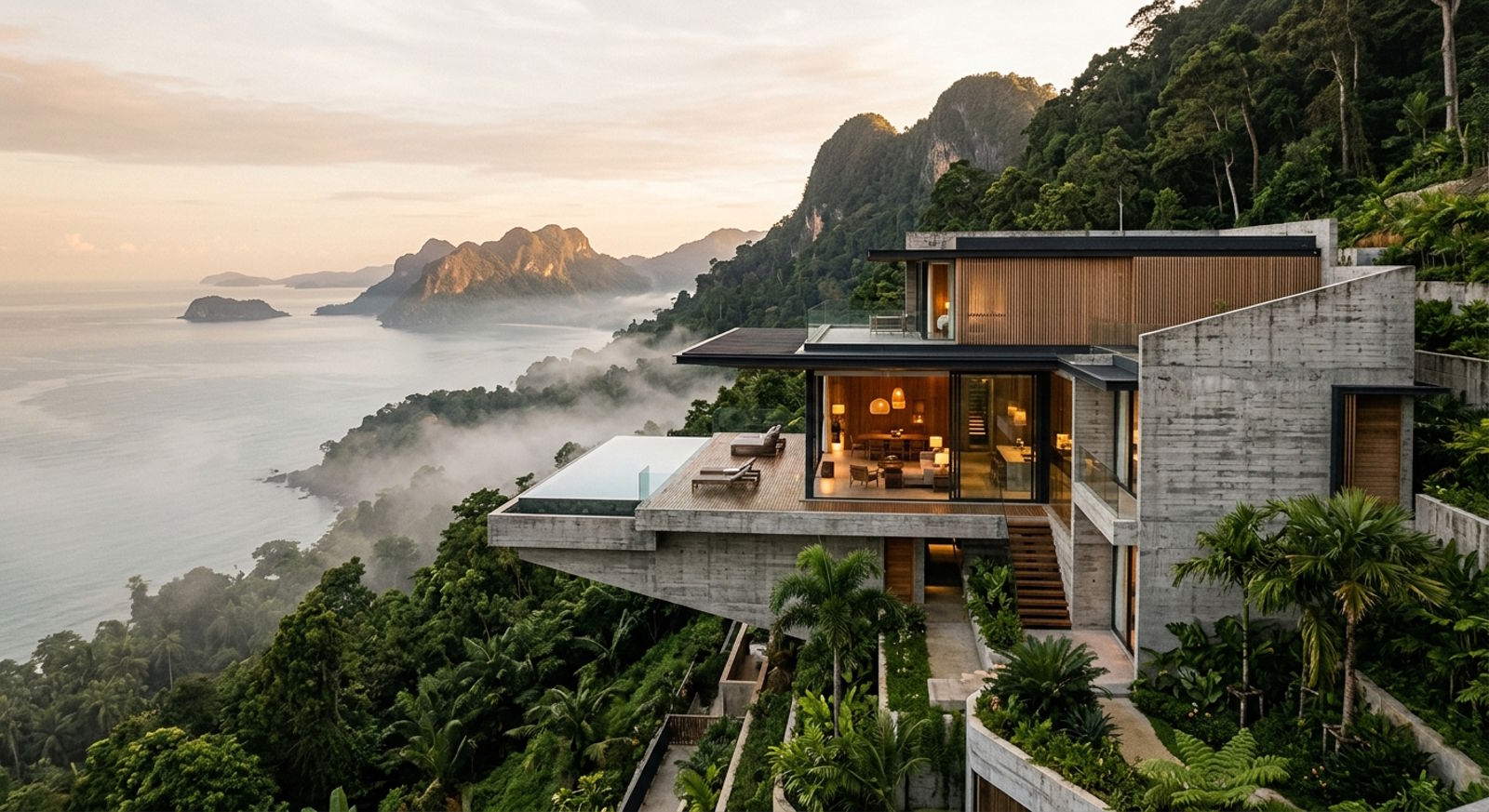
A villa overlooking the ocean, a home tucked into a lush hillside, a beachfront residence where the garden seems to merge with the sand, or a house beside a river surrounded by tropical vegetation: location is often what turns an attractive property into an exceptional one. It is also one of the things buyers should examine most carefully before making a decision.
- Key Takeaways
- Beachfront Living: Look Beyond the Sand
- Living With the Sea: Salt, Humidity and Maintenance
- Beachfront Privacy: Where Does Your Property Really End?
- A Sea View Deserves a Second Look
- Hillside Property: Understand the Ground Beneath the House
- Riverfront Property: Ask About the Wet Season
- The Property Is Only Part of the Drainage System
- Look Back Before Looking Forward
- Seclusion Comes With an Infrastructure Question
- Protected Nature or Simply Undeveloped?
- Can the Property Be Properly Insured?
- New Development or Existing Property? Both Tell You Something Different
- Look at the Property in More Than One Dimension
- FAQ
- What should I check before buying beachfront property abroad?
- Does buying beachfront property mean the beach is private?
- Can my sea view be protected?
- What should I check before buying a hillside property?
- How can I find out whether a property is at risk of flooding?
- Can nearby development affect flooding and drainage?
- What utilities should I check when buying a remote property?
- Why should I check historical satellite images before buying?
- Is undeveloped land next to a property protected from future construction?
- Should I check insurance before buying property abroad?
- Is an older property safer than a new development?
- Who should check a property before I buy abroad?
Some of the qualities international buyers are willing to pay a premium for, including privacy, direct beach access, panoramic views and untouched surroundings, depend on much more than the property itself. Weather, topography, drainage, public access, neighboring land, infrastructure and future development can all change how a location works in everyday life. Many of these characteristics are also difficult to judge during a property viewing. A beach in the dry season tells you little about a coastline during stormy weather, a quiet green plot next door does not tell you whether someone can build on it, and a beautifully secluded hillside villa may rely on a private road, its own water supply and independent wastewater systems.
None of this makes an extraordinary location less desirable. It simply makes understanding that location part of buying well.
Key Takeaways
Before buying property abroad, look beyond the house itself and evaluate the location as carefully as the building. Beachfront buyers should verify property boundaries, coastal setbacks, public beach access, privacy and seasonal conditions, while also considering the additional maintenance demands that can come with salt air and humidity. For hillside properties, slope conditions, drainage, retaining structures, road access and development above and below the property deserve particular attention. Riverfront and low-lying properties should be assessed with the wet season in mind, not only under ideal conditions.
The wider surroundings matter too. In rapidly developing areas, new roads, buildings, roofs and other hard surfaces can change how rainwater moves through an entire neighborhood. A panoramic view may be spectacular today, but buyers should understand what can legally be built on neighboring land in the future. The same applies to natural surroundings: there is an important difference between legally protected land and land that simply has not been developed yet.
Remote and secluded locations can offer exceptional privacy, but buyers should understand how electricity, water, wastewater and road access work in practice. Insurance is another consideration worth investigating before purchase, particularly for properties exposed to flooding, storms, coastal conditions or other location-specific risks. New developments can provide technical studies, engineering information and planning documentation, while existing properties offer something different: a history that can be examined. In either case, independent legal and technical due diligence becomes particularly important when the location itself is one of the property’s main selling points.
Beachfront Living: Look Beyond the Sand
There are few words in a property listing more enticing than “beachfront.” Direct access to the sea, uninterrupted views and the scarcity of prime coastal land make these homes particularly desirable in many international markets. But beachfront is also a good example of why buyers should look beyond the property itself.
How far is the building from the shoreline? Are there mandatory coastal setbacks? Has the shoreline changed over time? Is erosion known in the area? Are all parts of the property located on land where construction is legally permitted? Local planning rules can restrict construction close to coastlines, beaches, mangroves and other environmentally sensitive areas, and the rules can differ considerably not only between countries but also between regions. Buyers should therefore avoid making assumptions based simply on what already exists and have relevant land titles, boundaries, planning requirements and building approvals independently verified.
The physical location deserves the same attention. A beach that appears wide and calm throughout much of the year may look very different during seasonal storms, unusually high tides or periods of heavy swell. If historical information is available, looking at how the shoreline has changed over several years can provide useful context. Beaches are not static landscapes, and understanding how a particular stretch of coastline behaves can tell a buyer considerably more than a single viewing.
Living With the Sea: Salt, Humidity and Maintenance
Being close to the ocean changes more than the view. Salt-laden air, high humidity and exposure to coastal weather can place additional demands on a building and its equipment. Metal fixtures, railings, window systems, exterior lighting, air-conditioning equipment and exterior finishes may all require materials and maintenance appropriate for the environment.
This does not make a coastal home inherently more difficult to own, but it does make construction quality, material selection and maintenance planning more important. For a new property, buyers can ask which materials and technical systems were selected specifically for the coastal environment. For an existing home, its maintenance history can be particularly informative. Recurring corrosion, moisture problems or unusually frequent replacement of exterior components may indicate where future maintenance will be required.
It is also worth looking beyond what is immediately visible. Outdoor air-conditioning equipment, electrical installations and other mechanical systems may be exposed to the same coastal environment as the architecture itself. A beachfront premium should therefore be considered alongside the practical requirements of living beside the sea.
Beachfront Privacy: Where Does Your Property Really End?
Beachfront and private are not necessarily the same thing. A home may have direct access to a beach without owning the beach itself. Depending on local law, the stretch of sand beyond the garden may remain publicly accessible, or there may be rights of access along the coastline. For someone buying a beachfront home partly for privacy, that distinction matters.
Buyers should establish exactly where the private property ends and what rights the public may have beyond its boundaries. Is there an existing public access point nearby? Can people walk along the beach directly in front of the property? Are there restrictions on fences, walls or landscaping between the house and the shoreline? Can boats anchor close to the beach? These are practical questions, but they can have a considerable impact on how private a beachfront home actually feels.
It is equally important to look beyond the situation that exists on the day of purchase. Public infrastructure can change the relationship between a property and the coastline. Coastal footpaths, promenades, bicycle paths or new public access points can alter how the space between a home and the sea is used and, with it, the level of privacy the property provides. Privacy should therefore be assessed not only as it exists today, but also in the context of local planning and public access regulations. For a buyer paying a premium for seclusion, the essential question is simple: Where does my private space actually end?
A Sea View Deserves a Second Look
A panoramic sea view can add enormous appeal and value to a property.
An unobstructed sea view today does not automatically mean an unobstructed sea view forever. Buyers should understand the zoning of neighboring land and what may legally be constructed between the property and the view. If the view represents a significant part of the property’s appeal and price, it is worth establishing what could legally change in the future.
Hillside Property: Understand the Ground Beneath the House
Hillside homes can offer privacy, cooling breezes, natural surroundings and some of the most dramatic architecture imaginable. They also make the characteristics of the land particularly important. Natural slopes have their own drainage patterns, and construction can alter them just as development higher up a hill can affect properties below.
Buyers should understand not only how the house itself was engineered, but how it relates to the terrain around it. Appropriate professional assessments, the design of foundations and retaining structures, and the management of water during periods of intense rainfall all form part of that picture. What lies above and below the property matters, as does the natural direction of runoff and any substantial alteration of the slope to accommodate construction. Development higher up the hill can potentially change the amount and direction of water reaching properties below, while construction downhill may change the immediate physical environment around the property.
Access deserves the same attention. A steep private road that seems insignificant during a sunny viewing may feel very different after several days of tropical rain. Buyers should understand who owns and maintains the access road, whether access is legally secured and how the route performs during severe weather. The question is not simply whether you can reach the house on the day you view it, but whether you can reliably reach it when conditions are less than perfect.
Riverfront Property: Ask About the Wet Season
A river, stream or lagoon can completely transform the character of a property. As with the sea, however, the water visible during a viewing represents only one moment in time, and seasonal variations matter. A river that looks gentle during the dry season can behave very differently after several days of heavy rainfall. Buyers should understand historic water levels, flood zones where such information is available and how the surrounding landscape manages water during the wettest part of the year.
One simple question can reveal a great deal: What does this place look like after three days of heavy rain? Official information, engineers, long-term residents and neighboring property owners can each provide different pieces of the picture. Where practical, seeing an area during more than one season can also reveal things that are difficult to appreciate from plans, photographs or a single property viewing.
The same applies to access. A beautiful road running alongside a river or through low-lying land may operate perfectly throughout most of the year, but buyers should still understand whether it remains usable during periods of exceptional rainfall.
The Property Is Only Part of the Drainage System
One of the easiest mistakes to make is looking at a property as though it were an island. Water does not respect property boundaries, and this becomes particularly relevant in destinations experiencing rapid development. A house may have excellent drainage within its own grounds, yet construction elsewhere can change how water moves through an entire neighborhood.
Roads, roofs, driveways, terraces, swimming pools and other impermeable surfaces reduce the amount of ground available to absorb rainfall. As more land is covered by buildings and hard surfaces, stormwater management becomes increasingly important. Buyers should therefore look beyond the drains inside the property. Where does water come from and where does it go? Is the house lower than neighboring land? What is located uphill? Are there open drainage channels, culverts or municipal stormwater systems?
In coastal areas, tide levels may add another factor. Heavy rainfall coinciding with high tide can make drainage more difficult in some low-lying locations because water may not discharge as easily toward the sea. The quality and capacity of local stormwater infrastructure can therefore be just as important as drainage within the property itself.
This is also where history needs context. A statement such as “this property has never flooded” can be useful information, particularly for an established home, but buyers should also ask how the surrounding area has changed during that period. A neighborhood with large areas of open ground ten years ago may behave differently after extensive construction. The better question is not only whether a property has experienced flooding before, but how the site and its surroundings manage water today.
Look Back Before Looking Forward
Historical satellite imagery can be a surprisingly useful tool when evaluating an unfamiliar location. Rather than looking only at how an area appears today, buyers can look back several years and see how the surrounding landscape has evolved. Was the hillside once heavily vegetated? Has construction moved steadily uphill? Have large areas of open ground disappeared? Have new roads been built? Has the coastline visibly changed? Was the apparently empty neighboring plot always empty?
Satellite imagery cannot answer legal or engineering questions, but it can reveal patterns and raise useful questions for the professionals who can. Planning information provides the other half of the picture. Together, the past and the planning framework can provide a much clearer understanding of the environment around a property than the view from the terrace alone.
Seclusion Comes With an Infrastructure Question
Privacy and seclusion are among the great attractions of many overseas properties. A villa hidden in the hills or surrounded by nature can offer exactly the sense of escape a buyer is looking for. The more remote the setting, however, the more important it becomes to understand how the basic infrastructure works.
Electricity is a good place to start. Is the property connected to a reliable grid? Are outages common? Is there a backup generator, battery storage or another secondary power source? Water deserves the same attention. Is the property connected to a public supply, supplied by a private well or dependent on storage tanks or water deliveries? How much storage capacity is available, and does supply change seasonally?
For properties relying on private wells, water quality and the reliability of the source should be checked. In some coastal locations, groundwater conditions can also be affected by proximity to saltwater, making professional assessment particularly valuable. Wastewater is equally important. A property outside a municipal sewer network may rely on a septic system or another form of on-site wastewater treatment, so buyers should understand what system is installed, whether it is suitable for the property and site, and how it is maintained.
These questions become particularly important where a property is close to the coast, a river or groundwater, or where soil and drainage conditions are unusual. Infrastructure may not be the most glamorous part of a property viewing, but it has a significant influence on how comfortably an exceptional location works in everyday life.
Protected Nature or Simply Undeveloped?
“Surrounded by nature” can be one of the strongest selling points of a property, but there is an important distinction between land that is legally protected and land that simply has not been developed yet. A forested hillside, empty coastal plot or stretch of vegetation may create privacy and beautiful views today. Before assuming that landscape will remain unchanged, buyers should understand its planning and conservation status.
Protected forests, wetlands, mangroves, coastlines and other environmentally sensitive areas may be subject to restrictions that limit future development. Those protections can help preserve the surroundings, but they can also affect what owners are permitted to do on or around their own property. Undeveloped private land is different. If neighboring land has no formal protection, buyers should understand what could legally be built there in the future. A green outlook today could eventually become another residence, a larger development, a road or other infrastructure.
Untouched and protected are not synonyms. For someone paying a premium for natural surroundings, knowing the difference matters.
Can the Property Be Properly Insured?
Insurance is worth investigating before a purchase is completed, particularly when the location exposes a property to specific natural hazards. The relevant questions depend on where the property is located. Coastal storms, flooding, earthquakes, wildfires and other natural events may affect insurance availability, coverage limits, exclusions, deductibles and premiums.
The important question is not simply whether an insurance policy is available, but what the policy actually covers. Does it include flood damage, storm damage, landslides or earthquakes? Are there exclusions related to the property’s location or construction? Is the level of coverage appropriate for the value of the building and the cost of rebuilding locally?
Obtaining an insurance indication or preliminary quote before purchasing can provide useful additional information about future ownership costs and the coverage available for that particular property. It should not replace an independent assessment of the property or its location, but it can add another useful piece to the due diligence process. A spectacular setting can be worth paying a premium for; the cost and scope of protecting the property should simply be part of that calculation.
New Development or Existing Property? Both Tell You Something Different
New developments and established properties provide buyers with different types of information. With a new development, buyers can ask about the professional assessments and documentation behind the project. Depending on the location and type of development, these may include land documentation, planning and building approvals, engineering information, geotechnical assessments, drainage plans and environmental requirements. A well-planned project should be able to explain how the characteristics of its site have been addressed.
An established property offers something different: a history that can be examined. How has the building performed over time? Have there been drainage problems? Are there signs of persistent moisture or corrosion? How have retaining walls and foundations performed? Has the surrounding landscape changed substantially since the house was built? Maintenance records, previous ownership information and conversations with people who know the area can provide additional context.
Age alone is neither an advantage nor a disadvantage, nor does a new development automatically tell buyers more or less about a location. What matters is the quality of the information available and what independent due diligence reveals.
Look at the Property in More Than One Dimension
Beautiful property marketing naturally focuses on the best aspects of a home. That is part of selling a property. A buyer has a different task: to understand how all the elements surrounding that home fit together.
Look at the property on a map and consider its elevation and neighboring plots. Look backward through historical satellite imagery and ask about the wet season. Find out where rainwater goes, where the private land ends, what can be built nearby and whether public infrastructure is planned. Ask how electricity, water and wastewater work, what happens when the power goes out, how the access road performs after heavy rain and whether those beautiful green surroundings are actually protected. Insurance should be investigated before committing to the purchase as well.
If possible, talk to people who already live in the area. When a location is particularly unusual, directly beside the ocean, on a steep hillside, close to a river or surrounded by sensitive natural landscape, involving the appropriate independent specialist can add another layer of understanding before buying.
The objective is not to find reasons not to buy. It is to understand exactly what you are buying. After all, the characteristics that make a location exceptional are often the ones worth understanding most carefully before you fall in love with the view.
FAQ
What should I check before buying beachfront property abroad?
Buyers should verify property boundaries, coastal setbacks, building permissions, public beach access, shoreline conditions, seasonal weather and drainage. The additional maintenance requirements associated with salt air and humidity should also be considered, particularly when evaluating materials, exterior components and mechanical equipment.
Does buying beachfront property mean the beach is private?
No. Direct beach access does not necessarily mean that the beach itself is privately owned. Depending on local law, beaches may remain publicly accessible or be subject to public access rights. Buyers should establish where the private property ends and whether current or planned public access could affect privacy.
Can my sea view be protected?
That depends on local planning rules, neighboring land and the specific property. Buyers paying a premium for a view should establish what may legally be built between the property and the view and whether any formal protection exists.
What should I check before buying a hillside property?
Buyers may want to review slope conditions, appropriate site assessments, foundations, retaining structures, road access and drainage in addition to normal legal due diligence. Development above and below the property can also be relevant because changes to the surrounding terrain may affect runoff, access or the property’s immediate environment.
How can I find out whether a property is at risk of flooding?
Flood maps, planning information, historical records, site inspections and discussions with engineers and long-term residents can provide useful information where available. Buyers should also consider how the surrounding area has developed and how stormwater is currently managed rather than relying solely on whether the property has flooded in the past.
Can nearby development affect flooding and drainage?
Yes. Buildings, roads, roofs and other impermeable surfaces can reduce the amount of rainwater absorbed by the ground and alter how water moves through an area. Effective drainage and stormwater infrastructure become particularly important as neighborhoods become more densely developed.
What utilities should I check when buying a remote property?
Buyers should understand how the property receives electricity and water, whether backup power is available, how reliable the supply is and how wastewater is handled. Remote properties may rely on wells, water storage, deliveries, septic systems, generators or battery systems rather than municipal infrastructure.
Why should I check historical satellite images before buying?
Historical satellite imagery can help buyers understand how the area around a property has changed over time. It may reveal increasing development, loss of vegetation, new roads, changes to neighboring land or visible changes along the coastline. It does not replace professional due diligence, but it can help identify useful questions to ask.
Is undeveloped land next to a property protected from future construction?
Not necessarily. Land can remain undeveloped for many reasons. Buyers who value an open view, privacy or natural surroundings should establish the zoning and protection status of neighboring land rather than assuming it will remain unchanged.
Should I check insurance before buying property abroad?
Yes, particularly for properties in locations exposed to flooding, storms, earthquakes, wildfires or other natural hazards. Buyers should check not only the premium but also coverage limits, deductibles and exclusions for location-specific risks.
Is an older property safer than a new development?
Not necessarily. An established property provides a history that can be examined, while a new development may provide current engineering studies, planning documentation and newly designed infrastructure. Both should be assessed on their individual characteristics rather than age alone.
Who should check a property before I buy abroad?
The appropriate professionals depend on the country, location and property. Buyers commonly use an independent local lawyer for legal due diligence and may also require a surveyor, structural engineer, geotechnical engineer or another qualified specialist.