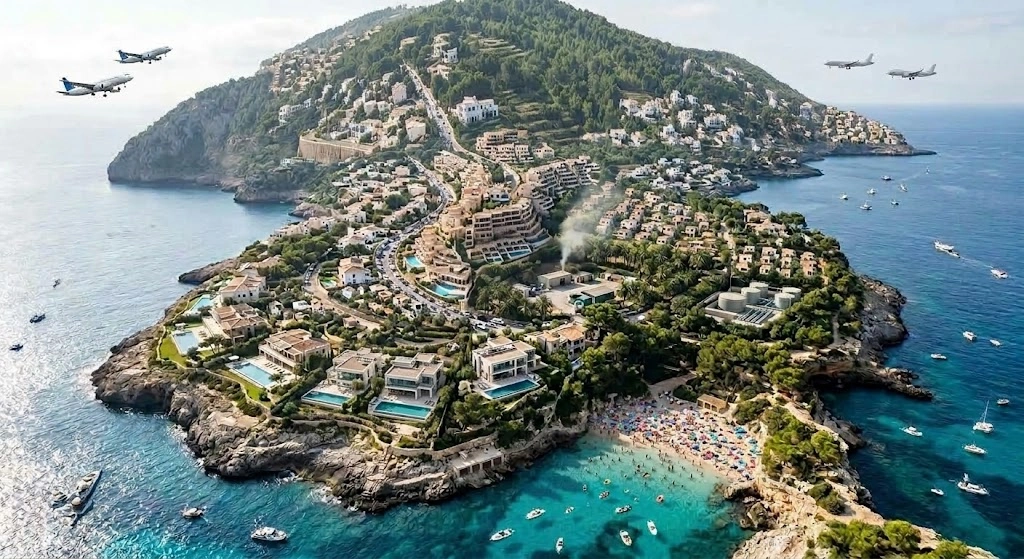
There is something uniquely persuasive about an island. The sea creates a natural boundary between the life you know and the one you imagine. Roads end at beaches rather than motorways, distances appear manageable, and even ordinary routines seem capable of becoming slightly more beautiful when they happen within sight of the water.
- Key Takeaways
- The Difference Between Visiting an Island and Living on One
- The Supply Test: Where Does Everything Come From?
- The Infrastructure Test: Look Beyond the Villa
- Where Does Everything Go?
- The Growth Test: Can the Island Absorb Its Own Success?
- Water May Be the Ultimate Limit
- The Waste Test
- Healthcare: What Happens After the Easy Cases?
- The Exit Route Matters as Much as the Arrival
- Seasonality Can Reveal a Different Island
- The Small Community Effect
- Houses Age Differently by the Sea
- Natural Hazards and the Question of Insurance
- Pets Make Geography More Complicated
- The Resale Test: What Happens If the Island Changes?
- Three Steps for Island Due Diligence
- The Final Island Test
- Frequently Asked Questions
- How long should I stay on an island before deciding to move there?
- What infrastructure should I investigate before buying island property?
- Is rapid property development on an island a good sign?
- Should I worry about water supply on an island?
- Are groceries and everyday goods always more expensive on islands?
- What should older buyers consider before retiring to an island?
- How can I tell whether an island is becoming overdeveloped?
- What is the most important question to ask before buying a home on an island?
It is easy to understand why islands exert such a strong pull on second home buyers, retirees and people considering a permanent move abroad. What is harder to see during a week in a hotel or a month in a rented villa is the complex system required to make permanent life there work.
The question, then, is not simply whether you would enjoy living on an island. It is whether the island can support the life you expect to live there, not just today, but ten or twenty years from now. For anyone considering a substantial property purchase or a permanent relocation, that makes the island itself part of the due diligence.
Key Takeaways
An island should be assessed as an infrastructure system, not simply as a location. Water, electricity, internet, healthcare, waste treatment, transport and supply chains matter as much as beaches, restaurants and property prices.
Rapid development can be positive when infrastructure expands with it. When it does not, growth can put pressure on roads, utilities, public services and the environment that originally made the island desirable.
Geographic isolation matters most when something goes wrong. Extreme weather, disrupted mainland transport, a closed port, a damaged cable or another crisis can expose dependencies that are almost invisible during normal times.
Property buyers should think about future livability as well as current desirability. A booming market is not necessarily a resilient one, and resale ultimately depends on future buyers wanting the lifestyle that surrounds the property.
The best way to understand an island is to test ordinary life rather than holiday life. Spend time there outside peak season, use local services and look beyond the immediate property to understand how the destination functions as a whole.
The Difference Between Visiting an Island and Living on One
A holiday is remarkably forgiving. If a restaurant is closed, you choose another. If the internet disappears for an afternoon, you go to the beach. If you need a specialist doctor, a new washing machine, a replacement part for the car or an important document from a government office, it can probably wait until you are home.
Permanent life is less accommodating, and the difference often becomes apparent not during extraordinary events but on an entirely ordinary Tuesday morning when something breaks, someone becomes ill or something you need simply is not available. The practical question is therefore surprisingly mundane: how much of your normal life depends on the mainland? The answer may be very different from what the island’s polished surface suggests.
The Supply Test: Where Does Everything Come From?
A well stocked supermarket can create the impression that an island is largely self sufficient. Few are. Food, medicine, fuel, construction materials, appliances, electronics, vehicle parts and countless other necessities may travel considerable distances before reaching their final destination. Some arrive by road and ferry, some by cargo vessel and others by air. Each additional stage adds cost and another potential point of failure.
Efficient ports, airports, warehouses and distribution networks can make geography almost irrelevant during normal times. The more revealing question is what happens when normal times are interrupted. The disruption does not even have to occur on the island itself. If flooding on the mainland cuts the primary highway connecting distribution centers with the port, delivery trucks may simply stop arriving. An island enjoying blue skies and perfectly calm seas can still experience shortages because roads hundreds of miles away are under water. Even sophisticated supermarkets and high end stores cannot sell what cannot reach them.
The same vulnerability becomes much more personal when something breaks. A luxury car may have an excellent local dealership, but that does not mean the required part is sitting in its workshop. A less common component may have to come from the mainland, the national capital or another country entirely, potentially leaving an otherwise perfectly functional vehicle unusable for weeks. Similar questions apply to imported kitchen equipment, pool pumps, air conditioning systems, elevators, solar installations and sophisticated home automation. Owning expensive things in a remote location is relatively easy; maintaining them depends on the logistics behind them.
There is a financial consequence too. Transport is embedded in the price of almost everything an island imports. For someone visiting for a fortnight, paying somewhat more for groceries, household goods or imported products is largely irrelevant. Over ten or twenty years of permanent residence, however, the cumulative island premium becomes part of the real cost of living.
The Infrastructure Test: Look Beyond the Villa
Property buyers naturally inspect the property they are buying. On an island, they should also investigate the systems surrounding it. A villa may have excellent water pressure, fast internet and uninterrupted electricity on the day of the viewing, but those facts reveal surprisingly little about the resilience of the networks behind them.
Electricity may be generated locally, transmitted from the mainland through subsea cables or supplied through a combination of different systems. Internet connectivity may depend on submarine fiber optic cables connecting the island to larger networks elsewhere. What matters is not simply whether these systems work, but whether alternatives exist when they do not. If a major transmission line or subsea cable is damaged, does the island have meaningful redundancy, or has one failure suddenly become everybody’s problem?
This is particularly relevant for anyone planning to work remotely or run an international business. Having fiber connected to the house sounds reassuring, but the cable running into the villa is merely the final few meters of a much larger system. Understanding how the island itself connects to the outside world can be considerably more important than the advertised speed of the home connection.
Where Does Everything Go?
What comes onto an island is only half of the equation. Eventually, something has to happen to what residents, businesses and visitors leave behind. Wastewater is not an especially glamorous subject for a property brochure, but over time it may matter more to quality of life than the marble chosen for the bathrooms.
The important questions are straightforward. Is there a functioning sewer network? How much wastewater is treated centrally? Are individual properties or entire developments dependent on septic systems? What happens during periods of exceptionally heavy rainfall, and have treatment facilities expanded at the same pace as the resident population, hotels and new residential construction?
Infrastructure can exist and still be inadequate. A treatment system designed for yesterday’s population may continue operating while becoming increasingly incapable of serving tomorrow’s. For coastal destinations, the consequences can eventually reach the very asset on which much of the island’s appeal and property value depends. A sea view loses some of its appeal when nobody wants to swim in the sea.
The Growth Test: Can the Island Absorb Its Own Success?
Development is not inherently a problem. Quite the opposite. New investment can bring better hospitals, international schools, improved roads, stronger utilities, better restaurants, more direct flights and services that would never have been economically viable for a smaller population. For residents and property owners, successful development can dramatically improve both convenience and quality of life.
The important distinction is between development and development that an island can absorb. Twenty new residential projects do not merely create twenty investment opportunities. They also mean more residents, more cars, more deliveries, more construction traffic and greater demand on utilities, healthcare and public services. A growing number of luxury villas says very little about whether the systems supporting that growth are expanding at the same speed.
This makes one question particularly useful when looking at a rapidly changing island: Can the island absorb its own success?
Construction cranes, new resorts and rising land prices can be signs of a thriving market. But if physical infrastructure consistently grows more slowly than the population it serves, the characteristics that attracted buyers can gradually begin to disappear. A quiet coastal road becomes a permanent traffic queue, journeys take longer, green space disappears behind walls and construction sites, beaches become busier and public services become increasingly stretched.
At some point, development can stop adding value and begin consuming the scarcity people were willing to pay for in the first place. The issue is not whether an island is changing. Successful places inevitably change. The more important question is whether planning and infrastructure are changing with it.
Water May Be the Ultimate Limit
Land is visible. Water capacity is not, which makes it particularly easy to overlook during a property boom. An island can add apartments, villas and hotel rooms surprisingly quickly, while increasing freshwater capacity may require major public infrastructure, long term planning and substantial energy.
Freshwater may come from rainfall, reservoirs, groundwater, imported supplies, desalination or a combination of several sources. Private developments may supplement public systems with wells, storage tanks or delivered water, but these solutions do not necessarily say much about the resilience of the island’s overall supply.
Desalination can provide an important solution in water constrained locations, but desalination plants require investment, electricity, maintenance and distribution infrastructure. Reservoirs have physical limits, while groundwater can be depleted or affected by saltwater intrusion. Tanker deliveries can keep individual properties functioning during shortages, but they do not resolve the underlying structural problem if demand across the island has exceeded sustainable supply.
For a buyer, the important question is therefore not whether water comes out of the tap today. It is whether the island’s water strategy appears capable of supporting the population and development planned for tomorrow. Real estate can be built plot by plot. Water infrastructure cannot.
The Waste Test
Every island has another finite resource that receives far less attention than beachfront land: somewhere to put things nobody wants anymore. A growing resident population combined with tourism, construction and imported consumer goods can produce enormous quantities of household waste, packaging, discarded furniture, building materials and commercial waste.
On a continent, waste can often be moved between regions relatively easily. Island geography narrows the options. Landfill capacity is finite, recycling depends on economically viable collection and transport systems, and sending waste elsewhere simply creates another logistics chain. Incineration can be part of the solution, but only where appropriate facilities, operating standards and emissions controls exist.
Where waste management fails to keep pace, the effects are not confined to an unattractive landfill hidden from visitors. Poorly managed sites can create odors, pests and water contamination, while open burning or fires at unmanaged waste sites can affect air quality over much larger areas. During dry periods, smoke from waste fires combined with vegetation fires can turn otherwise pristine island air into a seasonal health concern, particularly when weather conditions trap pollution rather than dispersing it.
For a prospective resident, the question is therefore not simply whether the beaches look clean. It is how the island manages the thousands of tons of material generated behind them.
Healthcare: What Happens After the Easy Cases?
Healthcare deserves a different kind of investigation. Most established island communities can handle routine medical needs perfectly well, which can make it tempting to tick the healthcare box after finding a good local hospital, clinic or doctor. The more useful investigation begins where ordinary treatment ends.
Where would you go for emergency surgery? Is there an intensive care unit? What about advanced cardiac care, oncology, dialysis, complex imaging or specialist treatment? Is blood readily available? Can a seriously ill patient be stabilized locally, and if not, how is that person transferred to a larger medical center? The existence of an airport does not automatically mean that medical transfer is simple at any hour and in any weather.
Age changes the importance of these questions. For a healthy buyer in their fifties, traveling occasionally for specialist treatment may seem entirely acceptable. Twenty or thirty years later, repeated journeys involving ferries, domestic flights or long road transfers can become exhausting or impractical. A retirement destination should therefore be assessed not only for the person you are when you buy, but for the person you may become while living there. A home that works beautifully at 58 does not automatically work at 82.
The Exit Route Matters as Much as the Arrival
Islands with international airports can feel almost indistinguishable from mainland destinations, while others depend on combinations of domestic flights, ferries, bridges or boats. In either case, the normal timetable tells only part of the story.
Before moving permanently, it is worth understanding how many genuinely independent ways there are to leave. What time is the last ferry? Can you travel at night during an emergency? Are flights frequently disrupted during a particular season? How many airlines operate useful routes rather than merely appearing on an airport’s destination list? If there is a bridge or a single major road connection, what happens when it is blocked?
The Covid era provided an unusually stark reminder that borders and geographic boundaries can suddenly matter again. Places accustomed to constant movement discovered how quickly access could change when governments restricted travel and transport networks contracted. A pandemic is an exceptional event, but the underlying lesson is broader: geographic isolation is easiest to ignore precisely when everything is working.
The same reasoning applies to storms, flooding, landslides, volcanic activity and other disruptions. Resilience is not about preparing for every imaginable disaster. It is about understanding whether an island has alternatives when one important system stops functioning.
Seasonality Can Reveal a Different Island
One of the least useful ways to judge an island is to experience it only during the season in which it is designed to impress you. An island in February may bear remarkably little resemblance to the same island in August, and the difference extends well beyond the weather.
In some destinations, the quieter season brings closed restaurants, fewer flights, reduced ferry services and a much smaller social world. Elsewhere, peak season is the more revealing test, with gridlocked roads, crowded beaches, overloaded services and prices that bear little resemblance to the rest of the year. Weather can expose another set of weaknesses. Persistent rain may reveal drainage problems that are invisible during the dry season, while strong winds or rough seas can affect transport and humidity can dramatically change the way a house feels and ages.
Anyone contemplating permanent island life should therefore try to experience the destination when it is least flattering. Paradise deserves an audition when it is having a bad month, not only when the weather, traffic and restaurant reservations are behaving perfectly.
The Small Community Effect
Physical infrastructure is only part of island life. Human infrastructure matters too. A smaller community can be one of an island’s greatest attractions: relationships form quickly, familiar faces become part of everyday life and a sense of belonging can be much stronger than in a large anonymous city.
The same intimacy can feel restrictive to someone accustomed to endless choice. There may be three excellent dentists rather than thirty, one good international school rather than six, a handful of reliable contractors and a limited number of specialists. If you dislike your accountant, builder, veterinarian or doctor, there may not always be an equally good alternative around the corner.
Socially, the same principle applies. Privacy and anonymity are relative concepts in smaller communities, particularly among international residents whose professional and social circles frequently overlap. For some people this creates precisely the community they were looking for; for others it eventually feels claustrophobic. Neither response is right or wrong, but it is something a holiday rarely reveals.
Houses Age Differently by the Sea
The property itself deserves an island test too. Salt air, intense sunlight, humidity, tropical rainfall, wind and insects can make a house age very differently from an equivalent property inland. Metal corrodes, paint deteriorates, electronics suffer, air conditioning systems work hard and mold can become a persistent maintenance issue. In some climates, termites add another layer of concern.
None of this makes coastal property a poor investment. It simply means that maintenance assumptions imported from another country may be unrealistic. Before buying, it is worth asking what comparable properties actually cost to maintain over ten years rather than relying on a development’s first year maintenance budget. Materials suitable for the local climate, preventative maintenance and access to competent specialist trades can make a significant difference, with availability of parts and equipment connecting directly to the supply chain considerations outlined earlier.
Natural Hazards and the Question of Insurance
Island destinations can be exposed to very different natural risks depending on their geography, including tropical storms, flooding, earthquakes, tsunamis, volcanic activity, wildfire, erosion and landslides. The useful question is not simply whether such events have happened before. Almost every desirable location carries some form of natural risk.
For a property buyer, the practical questions concern exposure and resilience. How is the house built? Where does it sit relative to the coast, slopes and known flood areas? What evacuation routes exist? How quickly can emergency services reach it? Is appropriate insurance available, what does it exclude and how might premiums change as risk models evolve?
A spectacular position can command a premium precisely because it is spectacular. That does not mean the physical consequences of that position should be treated as part of the romance.
Pets Make Geography More Complicated
Anyone moving with animals has another layer of island logistics to consider. Routine veterinary care may be excellent while specialist treatment requires travel, and certain medicines or prescription foods may need to be ordered from elsewhere. A large dog that travels easily by car on the mainland can become considerably harder to move when a ferry or aircraft is involved.
Import regulations are only the beginning. Owners should also consider what happens if they eventually leave, particularly if the next destination has different veterinary documentation, vaccination or quarantine requirements. Aircraft restrictions, seasonal heat rules and the availability of suitable routes can all affect the practical options.
Moving a pet abroad requires planning. Moving one to an island adds geography to the equation, both on arrival and on the day you may need to leave again.
The Resale Test: What Happens If the Island Changes?
Property investment introduces one final question that renters can largely ignore: what happens if you want to leave? During a rising market, liquidity can seem almost theoretical. New buyers arrive, developments sell and asking prices climb, making it tempting to assume that selling later will simply be the reverse of buying.
A property, however, has no independent existence from its surroundings. If congestion worsens, services become unreliable, beaches deteriorate, construction becomes relentless or the character of an area changes substantially, future buyers will evaluate those conditions too. This is why rising development activity deserves a nuanced interpretation. More investment can make an island considerably better, but it can also change the product being sold.
A secluded property surrounded by nature and the same property surrounded years later by dense development may occupy identical coordinates while representing two entirely different propositions. The crucial resale question is therefore not only what the property might be worth in ten years, but whether the people you expect to buy it from you will still want the lifestyle that comes with it.
Three Steps for Island Due Diligence
After researching individual issues, the challenge is turning them into a meaningful assessment. Rather than collecting an endless list of facts, it helps to approach the island in three stages.
- Live There Before You Commit
Do not recreate a holiday. Rent a home and establish an ordinary routine, preferably during a season that is not the destination’s most attractive. Drive at normal commuting times, shop for the things you actually buy, use local services and observe how much effort everyday tasks require. The objective is to discover friction: the small inconveniences that are insignificant for two weeks but become part of life when repeated for years.
- Follow the Systems Beyond Your Property
Once a particular area or development becomes serious, move beyond the sales material. A property’s utilities, access and services are only the final links in much larger systems. Understanding who provides those systems, how much capacity exists, what expansion is planned and where the weakest dependencies lie provides a far more useful picture than simply confirming that everything works today.
This is also where conversations with long term residents become valuable. Developers and agents can explain a property; people who have lived through several wet seasons, dry seasons, construction booms and infrastructure failures can often explain the place.
- Look Forward, Not Backward
The final stage is to stop evaluating the island you see today and consider the one that may exist when you eventually want to sell.
Look at development pipelines, population growth, major infrastructure projects and planning direction. Try to understand whether public and private investment is addressing the consequences of growth rather than simply creating more of it. The question is not whether the island will change, because it almost certainly will. The question is whether the direction of that change strengthens or weakens the reasons you wanted to live there in the first place.
This is particularly important for a second home or retirement property that may be held for decades. You are not merely buying today’s view, traffic conditions, water supply or neighborhood character. You are accepting a degree of exposure to what the island becomes.
The Final Island Test
There is no reason to conclude that island life is inherently more difficult, risky or expensive than life on the mainland. Some islands have sophisticated infrastructure, excellent healthcare, resilient supply networks and exceptionally high standards of living, while some mainland locations struggle with precisely the same problems discussed here.
The distinction is geography. An island has physical limits that are unusually easy to forget when everything functions well and unusually difficult to ignore when it does not. Water, land, roads, waste capacity and connections to the outside world are not abstract planning issues when your home, health and capital depend on them.
That makes the best island purchase less about finding paradise than understanding what keeps paradise running. Before reorganizing your life around a coastline, ask not only whether you love the place as it exists today, but whether its infrastructure, environment and community can support the place it is becoming.
Because the real island test is not whether you can imagine living there. It is whether the island can support the life you imagine living there.
Frequently Asked Questions
How long should I stay on an island before deciding to move there?
There is no universal minimum, but a short holiday is rarely enough to understand daily life. If possible, spend an extended period living in ordinary accommodation and experience at least part of the island’s less desirable season. The objective is not simply to see whether you still like the destination, but to understand what everyday life feels like once the holiday element has disappeared.
What infrastructure should I investigate before buying island property?
Think in terms of systems rather than individual amenities. Electricity, freshwater, wastewater, internet connectivity, transport, waste management, healthcare and emergency services all contribute to the long term viability of a location. The crucial issue is not whether these systems exist, but whether they are resilient and capable of supporting future demand.
Is rapid property development on an island a good sign?
It can be. New development may bring investment, services, employment and better infrastructure. The more revealing question is whether the systems surrounding that development are expanding with it. Construction itself demonstrates demand; it does not necessarily demonstrate capacity.
Should I worry about water supply on an island?
Water deserves particular attention because supply can be physically constrained while demand rises quickly. The relevant issue is not whether the current property has water, but how the island sources freshwater, how resilient those sources are and whether future capacity is being planned alongside new development.
Are groceries and everyday goods always more expensive on islands?
Not necessarily, particularly on large islands with substantial local production and efficient logistics. Imported goods, however, carry transportation and distribution costs, while limited competition can also affect prices. Comparing the cost of your actual lifestyle is more useful than relying on a generic cost of living index.
What should older buyers consider before retiring to an island?
The distinction between routine and specialist healthcare becomes increasingly important with age. A destination may offer excellent everyday medical care while complex treatment requires travel elsewhere. Buyers should consider not only today’s health needs but how practical those journeys would remain later in life.
How can I tell whether an island is becoming overdeveloped?
There is no universal threshold. Instead, look for a widening gap between growth and capacity. Development accompanied by infrastructure investment can improve an island substantially, while persistent congestion, overstretched public services and environmental deterioration may indicate that growth is beginning to exceed what existing systems can comfortably support.
What is the most important question to ask before buying a home on an island?
Perhaps the best question is not about the house at all: What will this island need in ten or twenty years if current development continues, and is anyone building it? A property can be renovated, extended or modernized. The infrastructure and environment surrounding it are much harder for an individual owner to change.