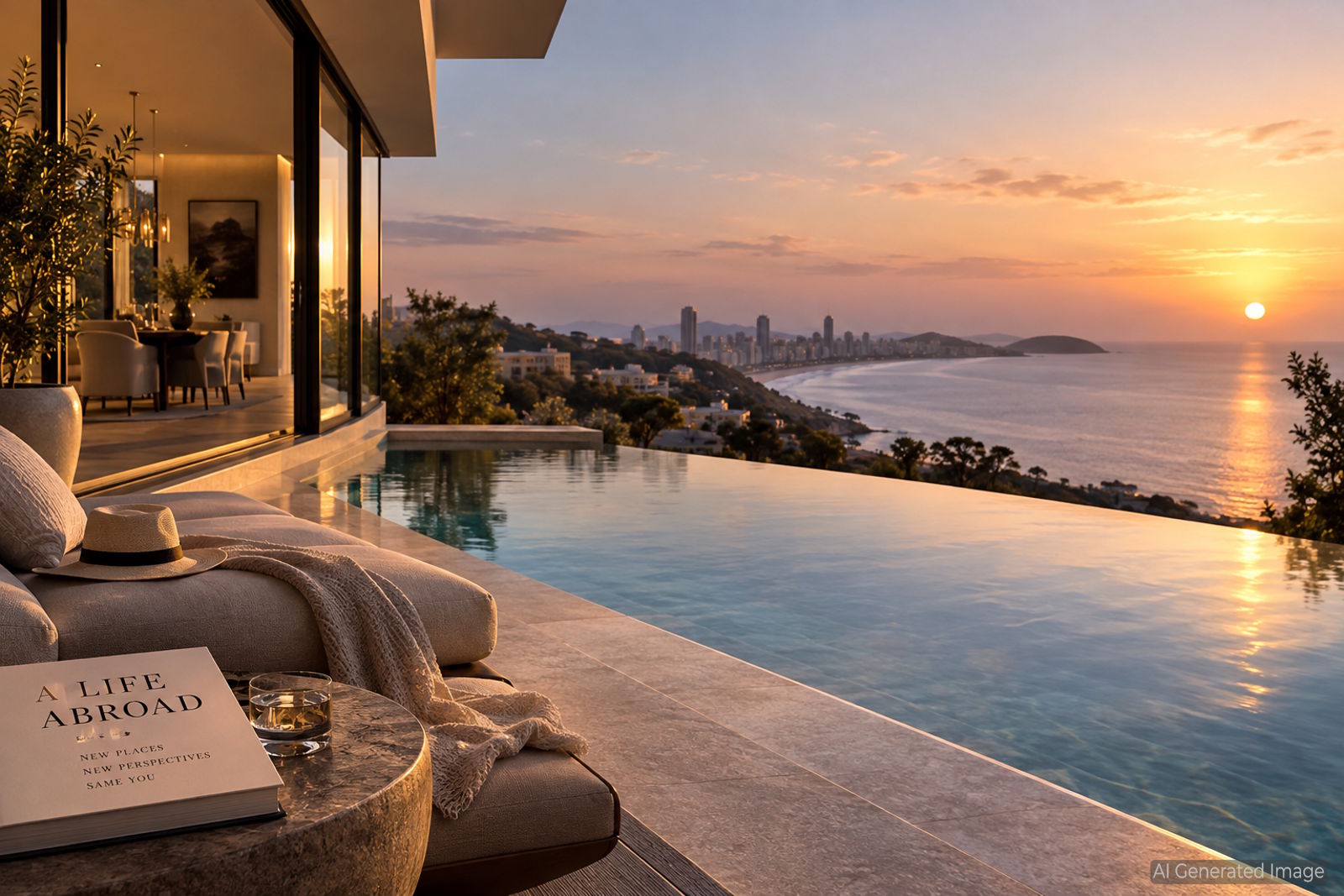
From hotel names and fashion houses to automotive icons, branded residences are changing the way international buyers think about a home abroad. Yet behind the polished lobbies, celebrated designers and reassuring names lies a more interesting question: what does a brand actually add to a place in which someone intends to live?
- Key Takeaways
- A Home You Can Leave Behind
- What Is a Branded Residence?
- From Hotel Service to Personal Identity
- Hotel Brands and Lifestyle Brands: Two Different Propositions
- Why International Buyers Are Drawn to Branded Residences
- The Brand Premium: What Are Buyers Actually Paying For?
- Does a Branded Residence Make a Better Investment?
- Why the Brand Matters to Developers
- What International Buyers Should Check Before Purchasing
- Understand the Brand Relationship
- Ask What Happens If the Brand Changes
- Look Beyond the Purchase Price
- Examine Rental Arrangements Carefully
- Understand What You Actually Own
- What Happens If the Brand Leaves?
- Beyond the Name
- Frequently Asked Questions
- What is a branded residence?
- Are branded residences more expensive than unbranded luxury properties?
- Do branded residences offer better rental returns?
- Are hotel-branded residences better than lifestyle-branded residences?
- Are branded residences suitable as second homes?
- Can foreigners buy branded residences?
- What happens if the brand leaves the development?
Key Takeaways
- Branded residences have moved well beyond the traditional hotel model. Hospitality groups now share the market with fashion, automotive, design and lifestyle brands.
- For international owners, convenience can matter as much as prestige. Professional management, security and ongoing maintenance can remove much of the practical burden of owning a home thousands of miles away.
- The brand premium deserves scrutiny. A celebrated name may add distinction and international recognition, but the underlying property, location and quality of development remain fundamental.
- Hotel and lifestyle brands offer different propositions. One tends to emphasize service and operational expertise; the other may place greater weight on architecture, design and identity.
- Due diligence remains essential. Buyers should understand service charges, rental arrangements, ownership structures and what happens if the relationship between the development and the brand eventually changes.
A Home You Can Leave Behind
There is a less glamorous side to owning a beautiful home abroad, and it tends to reveal itself shortly before departure.
The suitcases are packed, the airport transfer is waiting, and suddenly the swimming pool seems less like a luxury than something that will require looking after for the next four months. There is the air-conditioning to consider, perhaps a garden, the possibility of a leaking pipe, deliveries that might arrive after you have left and the perennial question of who, exactly, has the spare key.
None of these things is particularly complicated when home is ten minutes away. From another continent, even small practicalities have a habit of becoming long-distance management exercises involving neighbours, property managers, bank transfers and several messages sent across inconvenient time zones.
For people who divide their lives between countries, this is where the appeal of the branded residence begins to look rather different from the version presented in the sales gallery.
The marble lobby and private pool may photograph beautifully, but the ability to lock the door in April and return in November to find everything as it should be can be the more meaningful luxury.
For decades, branded residences addressed this problem through a relatively familiar model. A luxury hotel operator lent its name, standards and services to private homes, often alongside a hotel. Owners gained access to some combination of concierge services, housekeeping, maintenance, security and hospitality amenities while retaining a residence of their own.
That model remains important. It is simply no longer the only one.
Today, the name attached to a residence might belong to a hotel group, a fashion house, an automotive marque or a design-led lifestyle brand. In some developments there is no hotel at all.
The branded residence is evolving from an extension of hospitality into something broader: a particular interpretation of how affluent, internationally mobile owners want to live.
What Is a Branded Residence?
A branded residence is a privately owned home associated with an established brand and developed according to agreed standards of design, service, management or a combination of the three.
In a traditional hospitality-branded development, the connection is relatively intuitive. A hotel group may operate the property, provide resident services, maintain common areas and, in some cases, manage rentals on behalf of owners.
Lifestyle-branded residences can work differently. Here, architecture, interiors and identity may be more central to the proposition, while day-to-day operations are handled by another specialist company.
This distinction is important because the presence of a famous name does not tell a buyer precisely what that name is responsible for.
There is a considerable difference between a brand that has helped shape the architecture, interiors, service philosophy and resident experience and one whose most visible contribution is the logo above the entrance.
For a buyer, understanding that difference is far more useful than simply recognizing the name.
From Hotel Service to Personal Identity
Luxury property has traditionally been easy to describe in physical terms: an exceptional address, generous proportions, beautiful materials, privacy, views and amenities that would be difficult to reproduce in an ordinary home.
Much of that remains desirable. What has changed is the abundance of it.
In destinations with a substantial supply of high-end development, immaculate swimming pools, residents’ lounges, spas, gyms and imported stone are no longer unusual. Even excellent buildings can begin to resemble one another once their marketing brochures are placed side by side.
Branding offers developers one way to create distinction, but its appeal to buyers is more complicated than simple recognition.
A hotel brand may offer familiarity to someone who already knows its service culture from years of travel. A fashion or design brand may attract a buyer because its aesthetic feels immediately recognizable. An automotive brand can translate ideas of engineering, performance or exclusivity into architecture and interiors.
At this level of the market, a home can become an expression of taste in much the same way as art, furniture or a carefully chosen car.
That does not mean every buyer wants their home to make a statement. Quite the opposite. Some of the most successful luxury residences are compelling precisely because their identity is quiet.
What matters is coherence. The strongest branded projects tend to feel as though the brand belongs there, rather than having been added to make an otherwise conventional development easier to sell.
Hotel Brands and Lifestyle Brands: Two Different Propositions
Although both sit under the broad label of branded residences, hospitality and lifestyle brands can offer quite different experiences.
| Hospitality-Branded Residence | Lifestyle / Non-Hotel Branded Residence | |
| Typical emphasis | Service, convenience and operational consistency | Design, identity, architecture and exclusivity |
| Resident experience | Often closely connected to hotel-style services | Usually more residential and project-specific |
| Property management | Frequently integrated with the operator | May be provided by a separate specialist |
| Rental options | May include an established rental program | Varies considerably between developments |
| Particularly relevant for | International owners, frequent travellers and buyers seeking professional management | Design-conscious buyers, collectors and those attracted to a particular brand identity |
| Question worth asking | Will I actually use enough of the services to justify their ongoing cost? | How much substance lies behind the brand association? |
Neither model is inherently preferable.
Someone spending several months each year in Southeast Asia while maintaining a primary home in Europe may place enormous value on a residence that can be professionally maintained during long absences. Another buyer, purchasing a fourth home in Miami or Dubai, may care less about hotel-style services and considerably more about architecture, rarity and design.
The important distinction is therefore not which name appears more prestigious on paper, but which model corresponds to the way the owner intends to use the property.
Why International Buyers Are Drawn to Branded Residences
Owning a second home abroad has a peculiar way of turning small practicalities into long-distance problems.
A garden that needs tending is hardly worth mentioning when you live nearby. From London, Singapore or New York, it suddenly requires someone trustworthy on the ground. Pools need maintaining, air-conditioning systems dislike months of neglect, storms happen, appliances fail and even a routine repair becomes more complicated when the owner is several time zones away.
A well-managed residence centralizes many of these responsibilities. Depending on the development, that may include security, maintenance, housekeeping, management of private areas and preparation of the property before the owner’s arrival.
There is something particularly appealing about arriving after a long flight and finding that the residence has already been aired, cleaned and prepared, the lights work, the water is running and nobody needs to be called.
It is one of those forms of luxury that becomes noticeable precisely because nothing has gone wrong.
For buyers who divide their year between several countries, that predictability can have considerable value. The residence becomes somewhere they can arrive rather than another property they must administer.
This is also why branded living should not be understood purely as a status purchase. For some owners, the famous name may be secondary to the infrastructure behind it.
The Brand Premium: What Are Buyers Actually Paying For?
Branded residences frequently cost more than comparable unbranded homes, and the temptation is to regard the difference as the price of the name.
Sometimes that may be part of it. More often, the calculation is less straightforward.
The premium may reflect architecture, interior design, extensive amenities, professional management, international marketing, scarcity or a particularly strong location. It may also reflect the confidence buyers place in a familiar operator when purchasing in a country they do not know well.
The more useful question is therefore not simply whether a branded residence costs more, but what the additional expenditure actually buys.
If it results in a better building, stronger management, services the owner will genuinely use and a residence that remains distinctive in its market, the premium has substance behind it.
If most of the attraction disappears when the logo is mentally removed from the façade, the calculation becomes less convincing.
A useful exercise before purchasing is therefore to consider the property as though it were unbranded. The location should still be desirable, the architecture should still work, the floor plan should still suit the owner’s life and the developer should still inspire confidence.
A brand is at its most valuable when it enhances an already compelling property rather than compensating for an ordinary one.
Does a Branded Residence Make a Better Investment?
Not automatically.
Brand recognition can make a property easier to understand for an international audience and may help distinguish it from competing luxury developments. Professional management and established hospitality networks can also be attractive where owners intend to rent their homes while they are away.
None of this replaces the fundamentals of property investment.
Entry price, location, local supply, ownership rights, taxation, management costs, rental regulations and the quality of the developer remain important regardless of the name attached to the building.
Rental performance also deserves particular care.
A residence capable of commanding impressive nightly rates does not necessarily produce an equally impressive return for its owner. Service charges, management fees, reserve contributions, rental commissions and other operating costs can materially change the calculation.
International buyers considering rental income should therefore look beyond projected gross revenue and understand what is likely to remain after the costs associated with operating the residence have been deducted.
The brand can strengthen an investment proposition. It cannot create one by itself.
Why the Brand Matters to Developers
For developers, the appeal of a recognized brand is easy to understand, particularly in markets where luxury construction is expanding quickly.
A distinctive association can help a new project stand apart from dozens of developments competing for the attention of the same international buyers. It can provide a recognizable design language, introduce operational expertise and give prospective purchasers an immediate point of reference in an unfamiliar market.
Yet greater competition within branded real estate also raises expectations.
As buyers become more familiar with the concept, attaching a celebrated name to an otherwise conventional development may become less persuasive. The brand needs to be visible not merely in marketing but in the experience of the property itself.
Architecture, interiors, landscaping, amenities and service should tell a coherent story.
For developers, the more interesting question is therefore no longer simply which brand can be secured for a project. It is what that particular collaboration can create that would have been difficult to achieve without it.
The answer ultimately matters to buyers too. They are the ones who will still be living with the building long after the launch campaign has ended.
What International Buyers Should Check Before Purchasing
A branded residence may remove some of the practical complications of owning abroad, but it does not remove the need for careful due diligence.
In fact, the additional parties involved can create questions that do not arise in quite the same way with an independent home.
Understand the Brand Relationship
Buyers should establish what role the brand actually plays in the development.
Does it operate the property? Does it manage private residences? Is it responsible for services? Did it influence the architecture and interiors? Or has it primarily licensed its name and design standards?
These arrangements vary, and the distinction matters.
Ask What Happens If the Brand Changes
Brand and management relationships are contractual and may not last for the entire lifetime of a building.
The physical residence does not disappear if a brand eventually leaves, but management arrangements, services and market perception can change. Buyers should understand how the relevant agreements address such circumstances before purchasing.
Look Beyond the Purchase Price
Beautiful common areas and extensive resident services require ongoing funding.
Housekeeping, concierge teams, security, spas, pools, landscaped grounds and other amenities may create a wonderfully effortless ownership experience, but they also contribute to annual costs.
A buyer should therefore consider not only whether these expenses are affordable but whether the services are likely to be used enough to make them worthwhile.
Examine Rental Arrangements Carefully
Some branded developments offer owners access to professionally managed rental programs. These can be attractive to buyers who spend only part of the year in residence, but the terms vary considerably.
Management fees, revenue sharing, furnishing requirements and restrictions on personal use should all be understood in advance.
The last point can be particularly important. Owners often want to use second homes during precisely the same Christmas, New Year and holiday periods when rental demand is highest.
Understand What You Actually Own
The brand itself does not determine whether an international buyer can legally own the property.
Foreign ownership rules depend on the country, the type of property and the legal structure through which it is sold. Apartments, villas, land, freehold and leasehold interests can be treated very differently.
The glamour of the development should never distract from the decidedly unglamorous importance of understanding the title.
What Happens If the Brand Leaves?
This is perhaps the question most easily forgotten when standing inside a beautifully furnished sales suite.
A brand association can feel permanent because the building itself is permanent. Contractually, those are two different things.
If a brand relationship ends, the residence remains, as do its location, architecture and privately owned interiors. What may change are the services, management structure, marketing appeal and the expectations future buyers attach to the property.
The consequences will depend on how the development was structured in the first place.
This is another reason why the underlying real estate matters so much. A genuinely good home in an exceptional location retains qualities that do not depend on lettering above the entrance.
Beyond the Name
The most visible elements of branded living are inevitably the ones that make their way into brochures: dramatic architecture, immaculate pools, private lounges, beautiful restaurants and interiors designed to look effortless.
Yet for many international owners, the qualities that matter after purchase are considerably less photogenic.
It is knowing who answers when something needs repairing. It is returning after several months away without discovering a list of small problems waiting behind the door. It is being able to spend time in a home rather than spending the first week managing it.
A branded residence cannot guarantee that experience merely by carrying a famous name. The developer, operator, contractual structure and quality of execution matter just as much.
But when those elements come together, the appeal becomes understandable.
For some buyers, the freedom and individuality of an exceptional independent property will always be preferable. Others will gladly exchange a degree of independence, and a higher annual bill, for professional management and consistency.
Neither choice says very much about who appreciates luxury more.
It says considerably more about how they want to live.
And perhaps that is the most interesting development in the branded residence market. What began largely as an extension of the luxury hotel has become a response to a much broader change in international life: more people maintaining homes in different countries, spending longer periods away and placing an increasing value on properties that remain easy to own when they are not there.
The brand may be the first thing one notices.
The ability to leave, return and simply live may ultimately be what makes the address worthwhile.
Related Editorial Analysis
If you are evaluating international property markets, explore our foundational piece on market trends:
Why Branded Residences Continue To Gain Popularity Among Global Buyers
Frequently Asked Questions
What is a branded residence?
A branded residence is a privately owned home associated with an established hospitality, fashion, automotive, design or lifestyle brand. Depending on the development, the brand may influence architecture, interiors, management, services and resident amenities. The exact relationship differs between projects.
Are branded residences more expensive than unbranded luxury properties?
They often carry a premium, but the difference varies significantly between properties and markets. Buyers should consider what sits behind that premium, including location, architecture, management, amenities, scarcity and the strength of the underlying development, rather than assuming the brand itself guarantees additional value.
Do branded residences offer better rental returns?
Not necessarily. Professional management and brand recognition may support rental demand in some developments, but service charges, management fees, commissions and restrictions on owner usage can affect the final return. Buyers should examine expected net income rather than relying on advertised nightly rates or gross rental projections.
Are hotel-branded residences better than lifestyle-branded residences?
Neither model is inherently better. Hospitality brands tend to emphasize service, management and operational consistency, while lifestyle brands may focus more strongly on architecture, design and identity. The more suitable option depends on how the owner intends to use the property.
Are branded residences suitable as second homes?
They can be particularly attractive to international second-home owners because professional management, security and maintenance may reduce the practical burden of looking after a property from another country. Buyers should balance those benefits against the additional purchase premium and ongoing service costs.
Can foreigners buy branded residences?
Foreign ownership depends on the laws of the country and the legal structure of the property rather than on its brand. International buyers should establish whether they are purchasing freehold, leasehold or another form of ownership and obtain independent local legal advice before committing.
What happens if the brand leaves the development?
The privately owned residence normally remains, but management, services and the property’s market positioning may change. Buyers should understand the relevant branding and management arrangements, including what provisions apply if the relationship ends or a new operator is appointed.