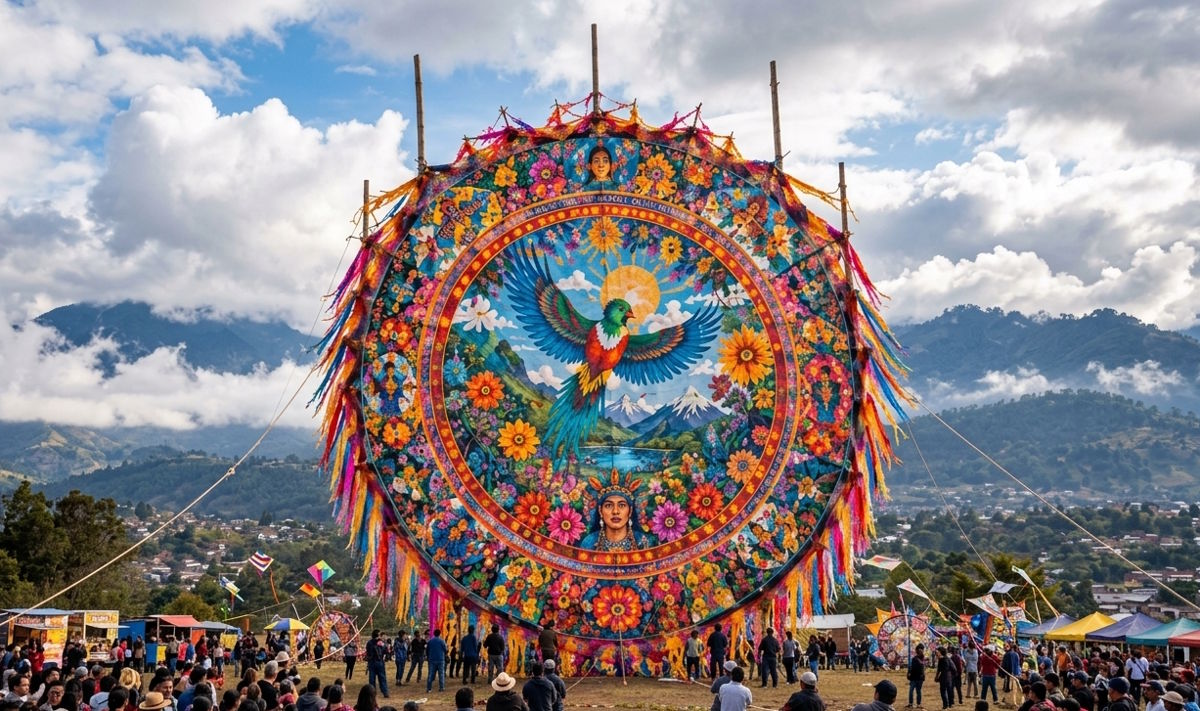
As the rainy season draws to a close in the Guatemalan highlands, two neighboring towns prepare for a day unlike any other. Here, enormous kites made of bamboo and colored paper bring generations together in a celebration where the memory of those who have died remains inseparable from the joy of being alive.
As October draws to a close in the Guatemalan highlands, the days grow a little shorter and the long rainy season begins to loosen its grip. Clouds still drift across the green mountains of Sacatepéquez, sometimes settling low enough to hide the villages scattered along their slopes. The mornings can be cool, the afternoons pleasantly mild, and the changing light lends the landscape a softness that seems particularly suited to the final weeks of the year.
In the towns of Sumpango and Santiago Sacatepéquez, however, the approaching first day of November brings anything but stillness. Behind doors and inside workshops, preparations that began months earlier are reaching their final stages. Families are planning gatherings, children are looking forward to the celebrations, and groups of kite makers are working against a deadline that has remained unchanged for generations. Soon, enormous circles of colored paper will stand against the mountains, transforming familiar places into an extraordinary landscape of art, remembrance, and celebration.
There is something wonderfully improbable about the whole undertaking. People spend months creating kites so large that some cannot possibly fly. They cut, arrange, and glue countless pieces of fragile paper, construct immense bamboo frameworks, and enlist the help of relatives, friends, and neighbors. Then, for a brief moment at the beginning of November, everything comes together. The work is admired, the achievement celebrated, and the tradition begins its journey toward another year.
The occasion is the Festival de Barriletes Gigantes, Guatemala’s Giant Kite Festival, celebrated on All Saints’ Day, November 1. For the Maya Kaqchikel communities of these neighboring towns, the kites carry a meaning that reaches beyond their extraordinary appearance. They are connected to the memory of ancestors, to family bonds, and to an understanding of life in which those who have died remain part of the community’s story.
The Weeks Before the Sky Fills With Color
It is tempting to imagine that a festival begins when the first visitors arrive, but in Sumpango and Santiago Sacatepéquez, November 1 is really the culmination of a much longer story. For months, groups of barrileteros, as the kite makers are known, have been turning their ideas into intricate works of art. Their workshops become places where technical skill, imagination, conversation, and companionship meet, often bringing together people of different ages who might otherwise have few opportunities to work so closely.
The materials are surprisingly ordinary. Bamboo, string, glue, and thin colored tissue paper form the basis of creations that can measure more than 20 meters across. Yet there is nothing ordinary about the patience required to make them. Each design begins as an idea, something the group wishes to express to the wider community. Sometimes the subject draws on Maya beliefs or cultural identity; sometimes it addresses the concerns of the present, including migration, environmental protection, or the importance of preserving Indigenous traditions.
Once the design has been agreed upon, the slow work begins. Pieces of papel de China, the delicate tissue paper used to create the images, are cut and layered until patterns, faces, landscapes, and symbols gradually emerge. The colors are often extraordinarily vivid, but their richness comes from the careful arrangement of paper rather than from conventional painting. The results can resemble enormous stained-glass windows, particularly when daylight passes through the translucent layers.
It is work that demands concentration, but it is also an opportunity to spend time together. A child who begins by watching an older relative may eventually learn to cut paper, prepare materials, or contribute to a design. What seems like a small task becomes the beginning of a skill that may remain with that child for a lifetime.
One of the kite makers interviewed for a documentary about the tradition described how his grandfather had made kites, followed by his father, and how he now hoped to pass the knowledge on to his own children. His account captures something that no description of dimensions or materials quite can. For him, making a kite is not simply about producing a beautiful object. It is a way of continuing a family story.
There is room for laughter, disagreement, ambition, and pride in such an undertaking. A design must be chosen, problems solved, and countless practical decisions made before the finished work can be displayed. The younger participants bring their own ideas, while the more experienced makers contribute techniques acquired over many years. The tradition survives because it belongs to all of them, rather than to a single generation.
When October Gives Way to November
As the final evening of October approaches, the atmosphere changes. The months of preparation are almost over, and the enormous artworks must finally be joined to the structures that will support them. In Sumpango, the night before the festival is known as the Lunada, when groups gather to assemble the giant kites and prepare the exhibition ground for the following day.
The scale of the task becomes apparent when the bamboo frameworks are brought into position. What may have seemed manageable in a workshop is suddenly an enormous structure that requires coordination, physical effort, and considerable care. The fragile paper must be protected as the framework is assembled, and every connection matters. A mistake at this stage could jeopardize months of work.
Meanwhile, in nearby Santiago Sacatepéquez, another gathering is taking place. Families make their way to the cemetery for the Ceremonia de Emponchados, a tradition associated with the evening of October 31. Wrapped in ponchos against the highland chill, they visit the graves of loved ones, bringing flowers and decorations to prepare for All Saints’ Day.
It is a beautiful contrast, and one that reveals the character of the celebrations. In one town, people are preparing enormous artworks that will soon dominate the landscape. In the other, families are tending the quiet resting places of those they remember. Both activities are expressions of the same approaching occasion, and both depend on the simple human act of making time for something that matters.
The cemetery is not merely a backdrop to the festivities in Santiago. It is a place of personal connection, where generations of families have come to remember parents, grandparents, children, and friends. The graves are decorated with flowers, bringing warmth and color to a setting that visitors from other cultures might expect to find solemn and silent.
Here, remembrance does not require the absence of everyday life. Families gather, relatives meet, children accompany their elders, and familiar conversations continue among the flowers and headstones. The people being remembered remain part of these gatherings through stories, traditions, and the relationships they helped create.
The Morning the Giants Rise
By November 1, Sumpango’s festival ground has become an extraordinary outdoor gallery. Against the green hills and the clouds that still linger over the mountains, giant circular kites stand in brilliant shades of red, blue, yellow, green, and violet. Their designs are so intricate that it is difficult to take them in at once. From a distance, they form a breathtaking panorama; closer inspection reveals the countless individual pieces of paper and the remarkable skill required to assemble them.
The sheer size of the creations is astonishing. Some rise higher than the surrounding buildings, their bamboo supports and carefully secured ropes revealing the considerable effort required to keep them upright. Visitors move between the displays, studying the details, photographing the artworks, and discovering the messages their makers have chosen to share.
For children, the sight of such enormous kites must be particularly remarkable. A familiar childhood object has grown to the proportions of a building, its surface transformed into an elaborate picture that seems almost impossible to have made by hand. Yet children are not simply spectators at this festival. Many have already participated in the preparations, and others will grow up knowing that one day they, too, might help create something of this scale.
The festival is also full of the ordinary pleasures that accompany a great communal gathering. People meet friends and relatives, food vendors prepare their specialties, and conversations compete with the bustle of the crowds. The aromas of cooking mingle with the cool mountain air, while the excitement of seeing the finished kites gives the day an unmistakably festive character.
And then there is the wind.
Not every giant kite is designed to fly. The largest creations are generally displayed upright, where their remarkable artwork can be appreciated in full. Smaller kites, however, may be launched when conditions permit, and watching one leave the ground is an entirely different experience.
Flying a kite several meters in diameter is no casual afternoon pastime. It requires a team of people working together, carefully managing the ropes while the wind pulls against the enormous paper surface. There is effort and uncertainty in the process, and success cannot be taken for granted. When a kite finally catches the wind, its fringes flutter and its long tail moves through the air, bringing to life an object that has occupied its makers for months.
For the local communities, this movement carries a spiritual meaning. The kites are traditionally understood as a symbolic means of connecting the living with their ancestors, while the sound made by their fluttering fringes is believed to help drive away harmful spirits. The sky becomes part of a tradition in which remembrance is expressed through movement, color, and sound rather than through silence alone.
It is easy to understand why the sight has captured the imagination of people far beyond Guatemala. Yet for those who have grown up with the festival, the moment is also deeply familiar, part of an annual rhythm that connects childhood memories with the present.
Flowers, Family Recipes, and the People Who Are Remembered
A short distance away, Santiago Sacatepéquez offers another perspective on the same tradition. Here, the giant kites are closely associated with the cemetery, where flowers, decorated graves, and enormous circular artworks create a scene unlike almost anything else in the world.
The combination can be surprising to visitors accustomed to more restrained expressions of mourning. There is color everywhere, and the gathering has a vitality that seems at odds with conventional ideas about death. But for the families who return each year, the occasion is not a contradiction. It is an opportunity to remember those who have died while spending time with the people who are still here.
Food is part of that experience, as it is in so many family celebrations around the world. One of Guatemala’s most beloved All Saints’ Day traditions is fiambre, an elaborate cold dish prepared with vegetables, pickled ingredients, cheeses, eggs, and assorted meats. Recipes vary considerably, and some contain dozens of ingredients, making the preparation a substantial family undertaking.
The dish is often associated with memories of mothers and grandmothers who prepared it in their own particular way. Recipes are handed down, adjusted, discussed, and defended, sometimes with the affectionate insistence that accompanies a cherished family tradition. Preparing fiambre can take several days, and the work offers another opportunity for generations to come together before November 1.
There is a natural connection between the food, the decorated graves, and the giant kites. Each requires care and preparation, and each allows people to participate in something that began long before they were born. The traditions endure not because every generation performs them in precisely the same way, but because each finds a reason to make them its own.
The celebration is therefore as much about the living as it is about the dead. Children encounter family customs that may one day become their responsibility, while older relatives have the opportunity to share memories and knowledge that might otherwise be lost. The day brings together people separated by age, experience, and sometimes distance, creating a sense of continuity that extends beyond the immediate occasion.
More Than a Beautiful Tradition
The giant kites have changed considerably over time. Smaller versions gradually developed into the monumental artworks seen today, and the subjects chosen by their makers have expanded to reflect the concerns of contemporary society. What began as a tradition associated with remembrance has also become a powerful form of public expression.
A kite may celebrate Maya heritage or depict a scene from local history. Another may address migration, the environment, or the challenges facing Indigenous communities. Some designs are joyful and exuberant, while others invite reflection on difficult subjects. Together, they offer a glimpse into the ideas and experiences of the people who create them.
The festival is particularly interesting because it makes room for these contemporary messages without abandoning its spiritual foundations. The connection with ancestors remains central, but the kites also speak to the present and, increasingly, to the future. The makers are not simply reproducing something inherited from their grandparents. They are adding their own voices to it.
In 2024, the traditional techniques of making the giant kites of Sumpango and Santiago Sacatepéquez were added to UNESCO’s Representative List of the Intangible Cultural Heritage of Humanity, recognizing the importance of the knowledge and communal relationships that sustain the practice.
The international recognition is significant, but the festival’s future ultimately rests with the people who continue to participate. As long as children are curious enough to learn, older makers are willing to teach, and families find meaning in returning each November, the tradition has the possibility of renewing itself.
Visiting the Giant Kite Festival in 2026
For travelers hoping to experience the celebration, November 1, 2026, falls on a Sunday. Both Sumpango and Santiago Sacatepéquez are within reach of Antigua Guatemala and Guatemala City, although the popularity of the festivals can make travel considerably slower than usual.
Sumpango is particularly rewarding for those interested in the monumental artworks and the atmosphere of a large public celebration. Santiago Sacatepéquez offers a closer encounter with the connection between the kites and the families gathering at the cemetery. Although the two towns are relatively close, trying to experience everything in a single day can be difficult, especially when roads are congested.
Arriving early is advisable, and accommodation in Antigua Guatemala can provide a convenient base. The highland climate is generally mild during the day, but mornings and evenings can be cool. Comfortable shoes, layered clothing, and some flexibility with the day’s plans are sensible precautions. The flight of individual kites depends on weather conditions, and the largest creations should be appreciated as monumental artworks rather than expected to take to the air.
Visitors should also remember that the celebration belongs first and foremost to the local communities. Particularly in Santiago’s cemetery, respect for families and their personal observances matters more than obtaining a photograph. Taking time to observe the craftsmanship, appreciate the messages within the designs, and understand the occasion’s significance will make the experience far more rewarding.
A Tradition Carried Forward
Eventually, the festival grounds begin to empty. The immense kites are lowered, families make their way home, and the villages return to the quieter routines of everyday life. The elaborate paper surfaces may be stored where possible, repaired, or eventually replaced, and the bamboo frameworks will no longer dominate the skyline.
Yet the work of the festival does not disappear with the passing of November 1. It continues in the relationships between the people who created the kites, in the skills younger participants have acquired, and in the family stories that have been shared during the celebrations.
Perhaps somewhere in Sumpango or Santiago Sacatepéquez, a child who spent the day looking up at those enormous circles of color will begin asking how they are made. An older relative may explain the first steps, show how the paper is handled, or recall a kite created many years earlier. Another small part of the tradition will have found its way into the next generation.
When October returns and the clouds once again drift across the Guatemalan mountains, the preparations will begin anew. Bamboo will be selected, paper arranged, and familiar groups will gather around fresh designs. There will be new ideas, new challenges, and new hands learning the work.
And when November 1 arrives, the giant kites will once again stand against the sky, bringing together the memories of those who came before and the lives of those who continue their story.
Frequently Asked Questions
When is Guatemala’s Giant Kite Festival in 2026?
The festival takes place on November 1, All Saints’ Day. In 2026, the date falls on a Sunday. Local event schedules and access arrangements should be checked closer to the celebration.
Where can visitors see the giant kites?
The principal celebrations take place in Sumpango and Santiago Sacatepéquez, two neighboring towns in Guatemala’s Sacatepéquez department. Sumpango is known for its large outdoor exhibition, while Santiago’s celebration is closely associated with the town cemetery.
What do the giant kites symbolize?
The kites are traditionally associated with communication between the living and their ancestors. The sound of their fluttering fringes is also believed to ward off harmful spirits.
Do all the giant kites fly?
No. Many of the largest kites are displayed upright because of their immense dimensions. Smaller kites can be flown with the help of teams of people when wind conditions are suitable.
How long does it take to make a giant kite?
Preparations can begin several months before the festival, with many groups working from July until the end of October. The process involves designing the artwork, assembling its colored-paper surface, and constructing the bamboo framework.
What is the difference between Sumpango and Santiago Sacatepéquez?
Sumpango’s festival is centered on a large exhibition ground, where the scale and artistic detail of the kites can be appreciated. In Santiago Sacatepéquez, the cemetery plays a central role, bringing the kites into close contact with the families commemorating their loved ones.
What is fiambre?
Fiambre is a traditional Guatemalan cold dish prepared around All Saints’ Day. It combines a wide variety of ingredients and is often made according to recipes passed down within families.