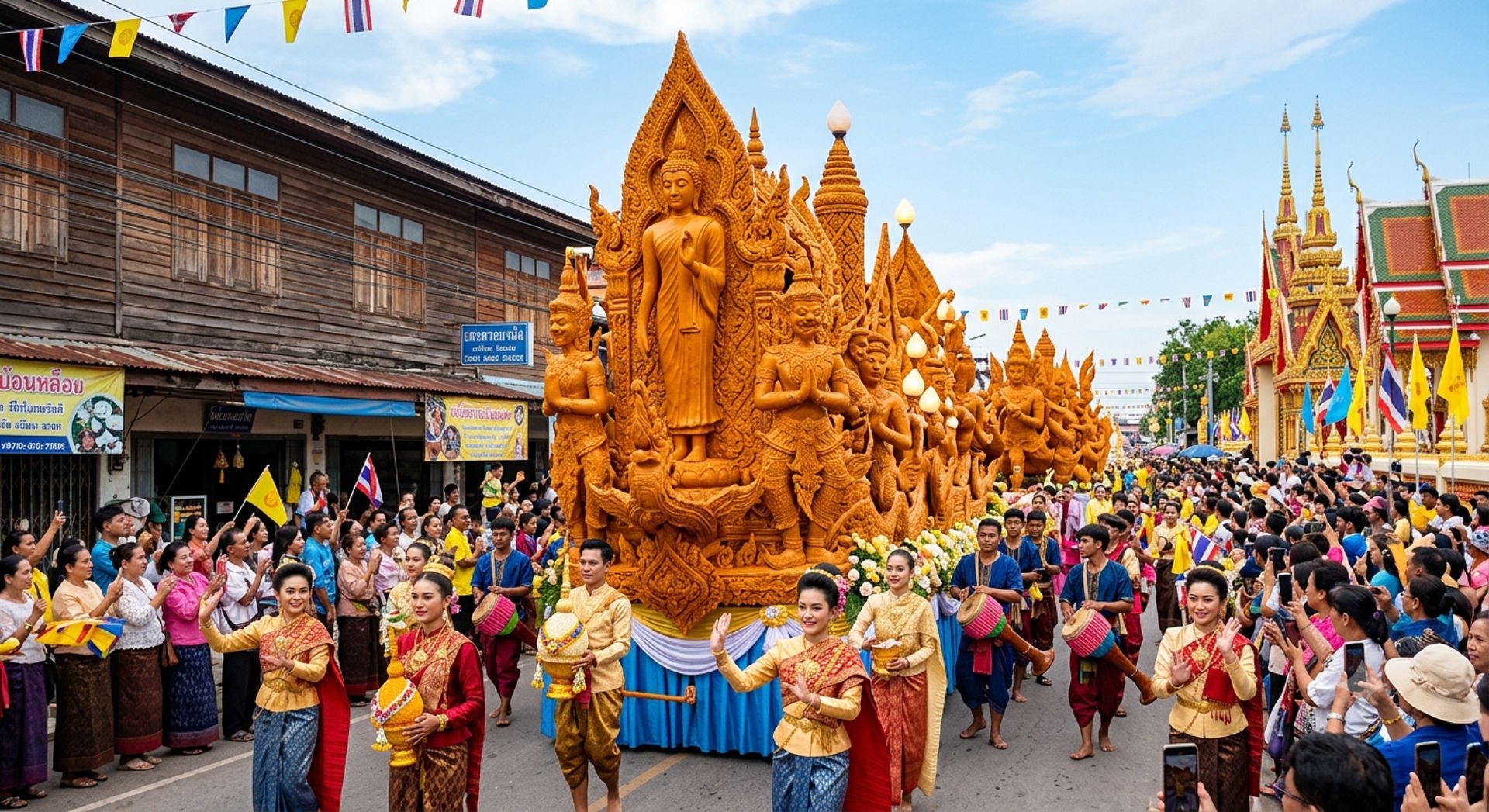
When looking for a new place to call home, finding the right property is only one part of the picture. Everyday life is shaped not only by modern infrastructure, the regional climate, or the cost of living—it is fundamentally formed by the traditions that bring people together. These cultural habits reveal how a community actually connects, what they value, and how they preserve their identity when the world around them changes rapidly.
You can see this play out beautifully in Isan, Thailand’s northeastern region.
International visitors often overlook Isan in favor of Bangkok or the country’s famous southern beaches, but the region offers a completely different side of Thai life. Here, things move at a slower, more deliberate pace. Neighborhoods stay tight-knit, and Buddhist traditions quietly influence daily routines in a way that feels incredibly grounded.
Every July, these quiet regional values take center stage in Ubon Ratchathani during the annual Candle Festival. While the massive wax sculptures are what make the headlines, the event itself is actually a window into a lifestyle where faith, centuries-old craftsmanship, and community remain woven into the fabric of ordinary life.
Why Ubon Ratchathani Became the Heart of the Festival
Candle processions happen all over Thailand, but Ubon Ratchathani is the undisputed home of the tradition. Tucked away in the far northeast near the borders of Laos and Cambodia, the province has spent generations holding onto customs that have faded elsewhere. While much of the country modernized at breakneck speed, Ubon kept its local identity intact.
The festival grew out of a simple, friendly rivalry between local temples. Decades ago, communities started trying to outdo one another with their ceremonial candles. What started as modest offerings slowly turned into a showcase of monumental art. Year after year, local carvers refined their skills, making the displays larger and far more intricate.
Today, the festival draws crowds from all over the country and beyond. But despite the growing attention, it has never turned into a commercialized spectacle. The preparation still relies entirely on the local community. It is a collective effort run by neighborhood volunteers, local monks, schools, and families—ensuring the event remains a genuine local tradition rather than just a cultural attraction.
The Roots of the Ritual: Light for the Rainy Months
To really understand why the festival matters, you have to look past the grand parade and look at the calendar.
The event marks the start of Vassa, known locally as Khao Phansa or Buddhist Lent. During this three-month rainy season, monks remain inside their temples to focus on meditation and study, pausing their travel to avoid trampling the young rice crops growing in the surrounding fields.
Centuries ago, before electricity, this presented a practical challenge. Temples needed a way to stay lit during long nights of prayers and study. The community’s solution was simple: they began donating large blocks of beeswax to their local temples.
Giving these candles was a practical act of support, but it was also a way for families to earn tam bun (merit) through generosity. Over generations, this blend of utility and devotion took on a creative life of its own. Simple wax blocks became decorated pieces, which eventually turned into the colossal sculptures seen today. What looks like a modern art exhibition actually started as a simple, neighborly chore to help the local monks get through the rainy season.
Where Faith Meets Craftsmanship
The scale of the floats is impressive, but the real story is the sheer amount of time and patience required to build them. Months before the festival begins, temple grounds turn into vibrant, open-air workshops.
The artisans rely on two traditional techniques that are fiercely preserved. The first is Tit Phim, where tiny, intricate wax patterns are molded individually and pressed onto a large frame to build up complex textures. The second, Kaew, is arguably even harder. Carvers take tools directly to massive, solid blocks of wax, slowly chipping away to reveal figures of the Buddha, guardians, and scenes from Buddhist folklore.
There is no room for mistakes. Everything is done by hand, taking weeks of quiet, careful labor. For the people involved, this demanding process isn’t just about art—the long hours of focused carving are considered a form of meditation and an act of devotion in itself.
Experiencing the Festival Beyond the Parade
If you only watch the main parade, you are missing the best part of the experience.
The real magic happens the evening before the official procession. On “display night,” the finished sculptures are parked around Thung Si Muang Park. Lit up against the night sky, the details in the wax look completely different than they do in broad daylight.
This is when the local community gathers in the streets. The area fills up with families, food vendors selling regional Isan dishes, and spontaneous circles of traditional music and dancing. It doesn’t feel like a staged festival; it feels like a massive neighborhood gathering where visitors happen to be welcome.
The next morning, the tone changes. The grand parade begins, and the giant wax creations move slowly through the city, flanked by hundreds of locals in embroidered regional costumes dancing to the distinct, fast-paced rhythm of northeastern Thai music. You are watching the culmination of months of shared hard work.
Behind the Scenes: The Spirit of Cooperation
If you are trying to picture what it’s actually like to live in this part of Thailand, look at the temples in late June.
Places like Wat Phra That Nong Bua and Wat Si Pradu become the center of neighborhood life. Master carvers teach younger apprentices, monks work right alongside teenagers, and older neighbors bring food and refreshments late into the night.
This environment perfectly highlights two core values of Thai society. First is tam bun—the idea of making merit through quiet generosity. Second is sanuk—the cultural belief that even demanding, repetitive work should be approached with a sense of fun and shared joy. These aren’t abstract philosophical concepts; they are practical rules for how people coexist here every day.
More Than a Festival
It is easy to view the Candle Festival as just another colorful event for a photographer’s portfolio. But the art is only the surface.
The festival survives because the underlying values remain strong. Patience, faith, and mutual support are put into practice by ordinary people doing their part for the neighborhood temple. For anyone looking at Thailand as a potential long-term home rather than a temporary vacation spot, this celebration is a clear look at the region’s authentic social fabric—quietly proud, deeply connected, and entirely built on community.
Final Thoughts
Thailand’s Candle Festival is frequently described as one of the country’s most beautiful cultural celebrations. While that may be true, its greatest significance extends far beyond the extraordinary wax sculptures that have made Ubon Ratchathani internationally known.
The festival reveals something more enduring: the values that continue to shape everyday life throughout much of Isan. For anyone considering Thailand as more than a holiday destination, it offers a rare opportunity to understand a region through the traditions its people continue to preserve. Sometimes, the best way to discover a place is not by visiting its landmarks. It is by witnessing the moments that bring an entire community together.
Is There a Cultural Tradition We Should Feature?
Cultural traditions usually tell you far more about a place than a standard guidebook ever can. If you know of a local ceremony, festival, or community event that offers a real look at the people behind a destination, we would love to hear about it. Share your suggestions and help us highlight the traditions that keep local communities grounded all over the world.