For first-time visitors, the scene can feel almost surreal.
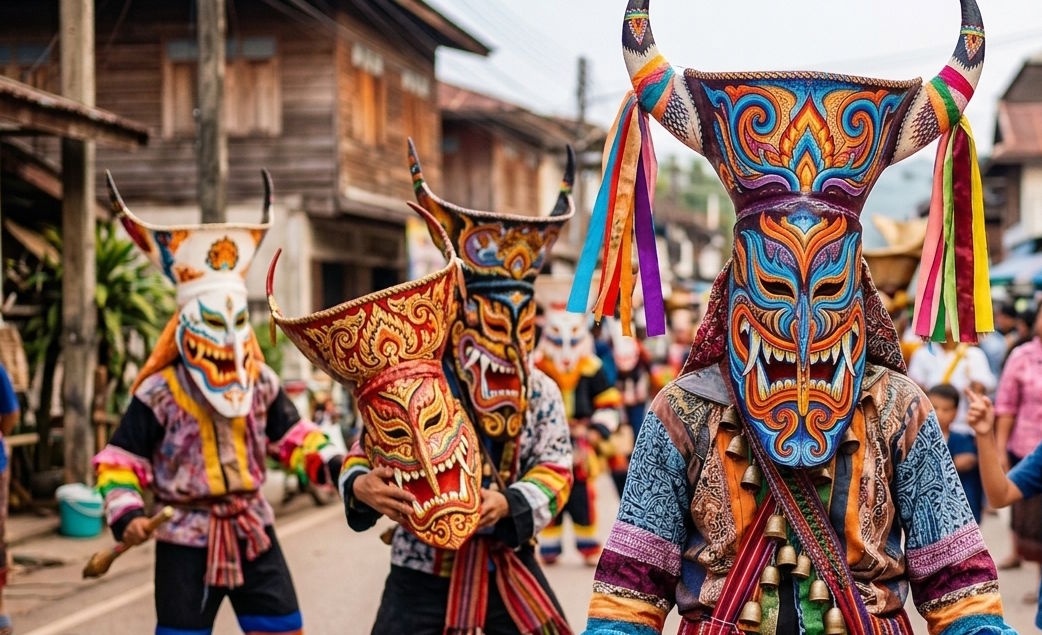
Towering masks with exaggerated features move through the streets. Costumed figures dance through cheering crowds. Bright colours fill every corner of the town while music, laughter and celebration continue long into the day.
At first glance, Thailand’s Phi Ta Khon Festival appears to be a vibrant costume parade unlike anything else in the world.
Yet beneath the colourful masks lies a tradition that has connected communities for generations and remains one of Thailand’s most fascinating cultural celebrations.
Held in the small town of Dan Sai in Thailand’s Loei Province, Phi Ta Khon is often referred to as Thailand’s Ghost Festival. While the name may sound mysterious, the event is far less about fear than it is about community, heritage and collective celebration.
Like many of the world’s most enduring festivals, its roots reach deep into local history and belief.
A Legend That Refused To Disappear
Several stories attempt to explain the origins of Phi Ta Khon, but the most widely accepted version is linked to one of the Jataka tales, stories recounting the previous lives of the Buddha.
According to local tradition, Prince Vessantara, a beloved prince known for his generosity, returned to his kingdom after a long absence. The celebrations were said to be so joyful that even spirits and supernatural beings joined the procession to welcome him home.
Over time, local communities transformed this legend into a festival unlike any other.
The elaborate masks, often handcrafted from bamboo baskets, coconut husks and painted wood, came to represent the spirits who joined the celebration. What began as folklore gradually evolved into an annual event that continues to define the identity of the region.
More Than Costumes And Masks
Although the masks attract most of the attention, Phi Ta Khon is about far more than visual spectacle.
For the people of Dan Sai, the festival represents an important expression of local culture and community pride. Families participate together, traditions are passed from one generation to the next and entire neighbourhoods become involved in the preparations.
Months of work often go into creating the elaborate costumes and masks that appear during the festivities. Each design reflects individual creativity while remaining connected to the broader traditions that make the festival unique.
What visitors see during a few days of celebration is often the result of countless hours of craftsmanship and community involvement.
Where Tradition And Celebration Meet
One of the most fascinating aspects of Phi Ta Khon is the way it combines different layers of cultural identity.
Elements of Buddhist belief sit comfortably alongside local folklore and ancient traditions. Religious ceremonies take place alongside street celebrations. Spiritual symbolism exists alongside humour, music and entertainment.
Rather than separating these influences, the festival embraces them.
The result is an event that feels both deeply meaningful and remarkably joyful.
It serves as a reminder that culture is rarely simple. Traditions evolve over time, absorbing influences from different generations while remaining connected to their origins.
Phi Ta Khon is a perfect example of that process.
A Celebration Of Community
Perhaps the most remarkable aspect of the festival is not the masks themselves but the role they play in bringing people together.
Like many traditional festivals around the world, Phi Ta Khon creates a shared experience that strengthens community bonds. Residents who may spend much of the year focused on everyday life come together to organise, prepare and celebrate.
For younger generations, the festival provides an opportunity to learn traditions that might otherwise fade over time. For older residents, it offers a chance to pass knowledge forward while maintaining a sense of continuity with the past.
The festival is not simply something that happens in Dan Sai.
It is something the community creates together.
Beyond Thailand’s Famous Destinations
When people think of Thailand, they often picture tropical islands, bustling markets or famous temples.
Yet some of the country’s most memorable cultural experiences are found far from the well-known tourist routes.
Dan Sai sits in Thailand’s northeastern region of Isan, an area that many international visitors never explore. Events like Phi Ta Khon offer a glimpse into a side of the country that remains deeply connected to local traditions and regional identity.
For travellers seeking experiences that go beyond guidebooks and resort destinations, festivals like this often provide some of the most meaningful insights into a culture.
They reveal not only how people celebrate, but also what communities choose to preserve.
Why Festivals Like This Matter
In an increasingly connected world, traditions can easily become diluted or forgotten.
Events such as Phi Ta Khon demonstrate the importance of cultural continuity. They provide opportunities for communities to celebrate their heritage while sharing it with future generations.
For visitors, they offer something equally valuable.
A chance to move beyond sightseeing and witness culture as a living, evolving part of everyday life.
The masks may be what first capture attention.
The story behind them is what people tend to remember.
Final Thoughts
Phi Ta Khon is often described as Thailand’s Ghost Festival, but that description only scratches the surface.
At its heart, the festival is a celebration of community, storytelling and cultural identity. It transforms local legends into living tradition and reminds us that some of the world’s most memorable experiences are not found in famous landmarks, but in the customs and celebrations that continue to bring people together year after year.
For those willing to venture beyond the familiar, Dan Sai offers an unforgettable glimpse into a side of Thailand that many travellers never see.
And perhaps that is exactly what makes the experience so special.
Is There A Festival We Should Feature?
Around the world, countless festivals preserve traditions, strengthen communities and tell stories that deserve to be shared.
If you know of a celebration, cultural event or local tradition that deserves a place on Bucketlist, we’d love to hear your suggestion.