For generations, the societal script for retirement was dictated by a clean, predictable conclusion. After decades of professional output, individuals reached a designated age, surrendered their responsibilities, and stepped away from the economic machine. Retirement was universally understood as the beginning of a decelerated chapter—a well-earned period of rest, quiet leisure, and passive consumption.
Increasingly, however, the global reality looks entirely different.
Walk into the vibrant co-working spaces of Lisbon, the boutique cafes of Chiang Mai, or the coastal creative hubs of Mexico, and you will find a rising demographic that completely defies this traditional timeline. These are not tourists drifting between golf courses; they are retirees launching businesses, consulting for global firms, writing books, mentoring startups, and establishing new entrepreneurial ventures abroad.
For this cohort, a relocation overseas is no longer an escape or a final curtain. It has become the ultimate startup project, funded by a lifetime of capital and experience.
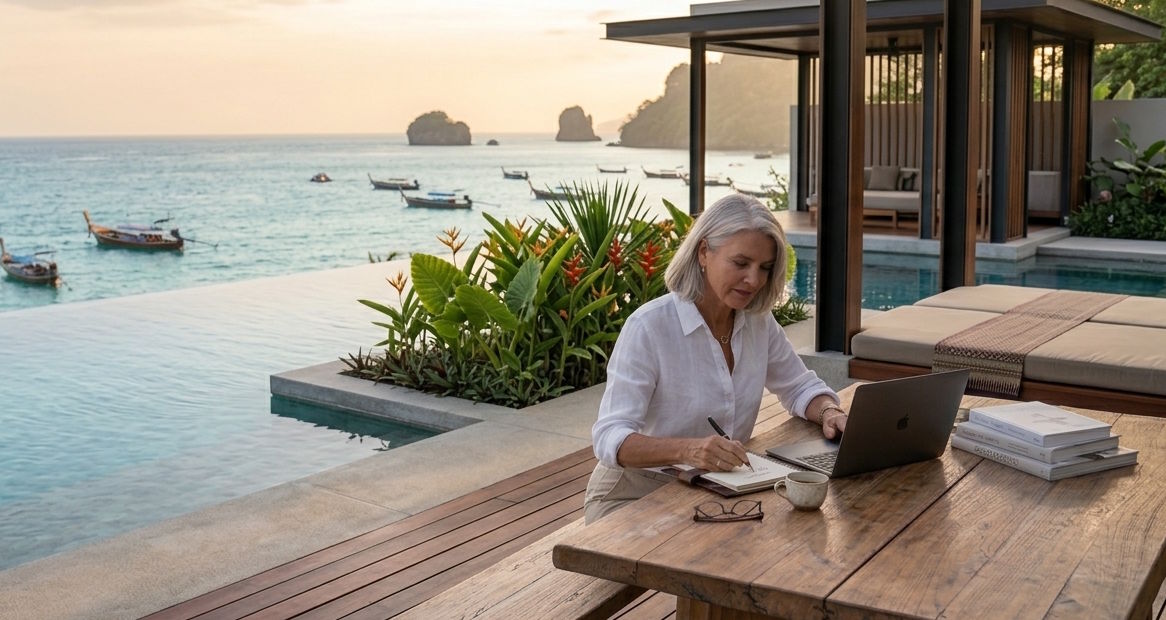
This systemic pivot directly reshapes how foreign property markets and international communities must be evaluated. When a luxury villa or an ancestral estate is purchased abroad today, it is rarely bought merely as a sanctuary for doing nothing. It is being acquired as the operational headquarters for a second, more liberated professional life.
The Capital of Experience
Part of this cultural evolution stems from a simple demographic reality: longevity. Someone entering retirement today in their early sixties can reasonably look forward to twenty or thirty active, healthy years. Viewed through this lens, treating a quarter of one’s life as a permanent vacation is not just unappealing; it is a psychological burden.
Furthermore, the structural nature of modern work has fundamentally decoupled productivity from the traditional office cubicle. Expertise does not expire at sixty-five, nor does a global professional network evaporate. Because high-value consulting, digital commerce, and project management can now be executed from anywhere with a fiber-optic connection, work has transformed from a daily obligation into a selective luxury.
Where the old script demanded an absolute stop followed by passive leisure, the modern transition values independence as a launchpad for selective ventures from a global base.
What these individuals are seeking is not the absence of activity, but absolute autonomy over their time. The objective of launching a boutique enterprise or managing an international investment portfolio from a terrace abroad is rarely driven by financial necessity. It is driven by the desire for intellectual friction, personal autonomy, and the human need to remain relevant and engaged with a changing world.
Redefining the Luxury Landscape
This shift has profound implications for the global lifestyle market. For decades, traditional retirement destinations were aggressively marketed around a rigid, predictable triad: endless sunshine, low living costs, and a slow, undemanding pace of life. While these baseline metrics remain comforting, they are no longer the primary driver for the modern global citizen.
The contemporary pioneer is not looking for a destination that allows them to do less. They are looking for an ecosystem that enables them to do more.
They want immediate access to nature, but they also require proximity to cultural capital. They want tranquil privacy, but they need an active, intellectually stimulating community of peers. They are not looking to blend into an insulated expat enclave that spends its afternoons discussing the local cost of groceries; they want to integrate into environments where ideas are exchanged and new passions can take root.
Property features like pool sizes or beach proximity only tell half the story. The real priority is whether the destination serves as a dynamic launchpad for travel and projects, or if it is merely a beautiful dead end.
The Ultimate Executive Freedom
Perhaps the most outdated fallacy regarding retirement is the belief that it represents a period of downsizing. In reality, it is often the first time in an adult’s life where true expansion is possible. For the first time, projects do not have to fit around the rigid demands of a corporate hierarchy or the pressures of raising a family.
Choosing a new home abroad at this stage of life is a profound statement of intent. It is an acknowledgment that a house is not simply a structure of concrete and glass, but a framework for the daily habits, relationships, and intellectual pursuits you choose to cultivate.
The traditional ideal of retirement promised the luxury of stopping. But for a growing and highly influential segment of the global population, the true luxury lies in the freedom to begin again. Retirement is no longer about leaving a legacy behind; it is about finally having the time, the clarity, and the independence to build something entirely new.
Are You Building Your Next Chapter Abroad?
The transition into an active retirement requires more than a change of scenery—it requires an environment that matches your ambitions. If you have relocated overseas to launch a new venture, project, or passion, we want to hear how your new surroundings have shaped your work.
Connect with our editorial team through our contact form and share your experience of building a new chapter on global ground.