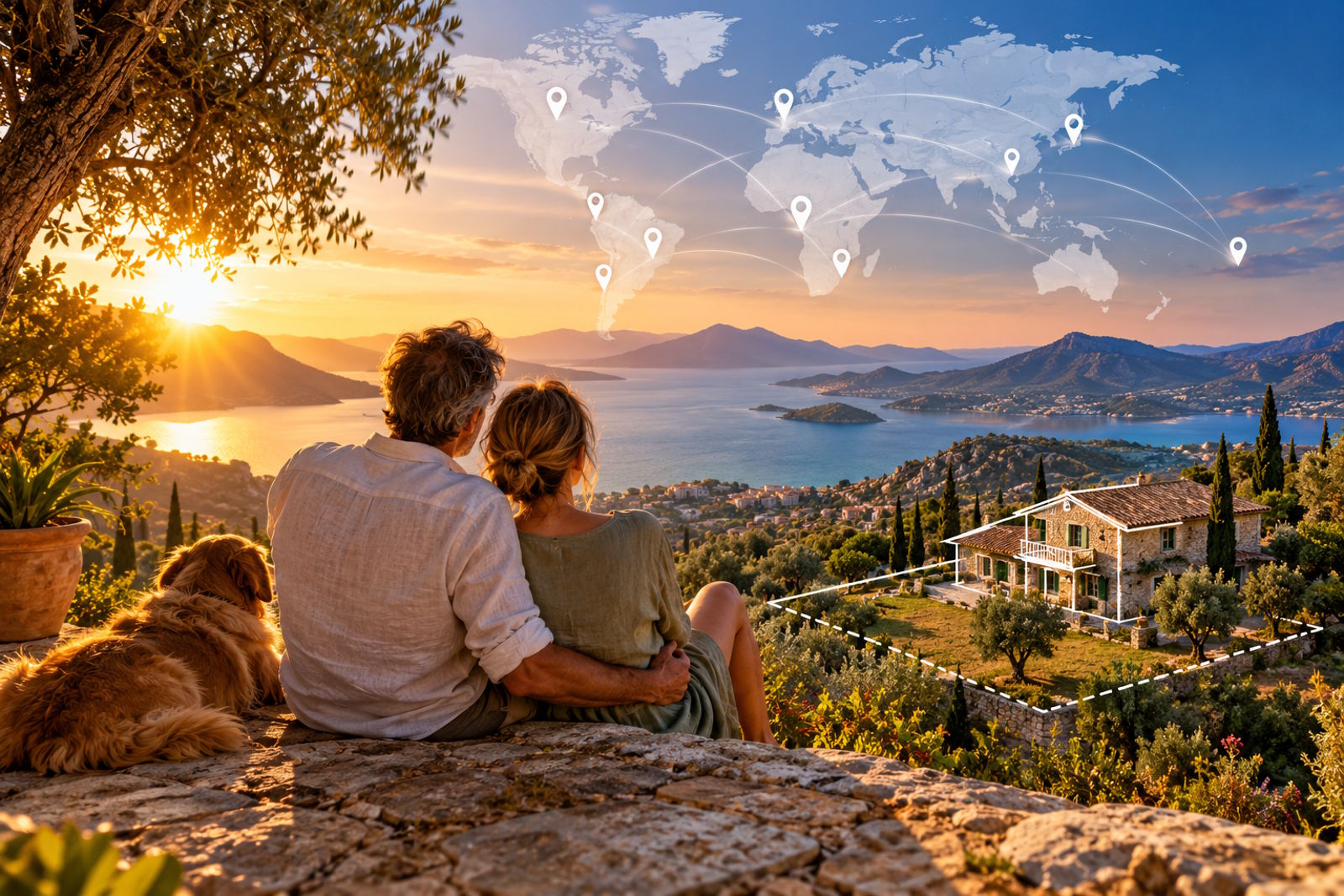
From the mountains of South America to the Atlantic islands of Cabo Verde and the countryside of Japan, exploring where foreign buyers may truly own the land beneath their homes.
- What Does It Really Mean to Own Land?
- A World of Possibilities Beyond Familiar Destinations
- The Americas: From Tropical Coastlines to Mountain Landscapes
- Africa: Discovering Opportunities Beyond the Familiar
- Asia: An Unexpected Freedom in Japan
- Europe: Familiar Places, Different Rules
- Where Can Foreigners Buy Land Outright?
- The Land May Be Yours. The Right to Live There Is Another Matter.
- Before You Buy, Protect What You Have Built
- A Home Is More Than an Investment
- Key Takeaways
- Frequently Asked Questions
- Can foreigners buy land without living in the country?
- What happens when a long-term land lease expires?
- Can I buy agricultural land abroad?
- How can I verify that I will actually own the land?
- Can I build a house on land I own?
- Does buying land give me permanent residency?
- Should I sell my home before purchasing property abroad?
- Important Legal Disclaimer
There is something deeply personal about owning a piece of land. Perhaps it is a garden planted over decades, a house filled with family memories, or simply the reassuring knowledge that the ground beneath your feet belongs to you.
For some people, the desire to begin again comes later in life. A couple may have spent forty years in the same home, only to discover that the winters feel longer, maintaining the property has become increasingly demanding, or the people they once lived close to have moved elsewhere. What once felt like the perfect place to grow old may no longer suit the life they want to lead.
For others, the decision comes much earlier, often with children in tow. Some families are searching for a different educational environment, perhaps one that encourages creativity, practical learning, greater independence, or a more international perspective. Others want their children to grow up surrounded by nature, experience another culture, or enjoy a family life that feels less dictated by familiar routines.
Then there are those who have always dreamed of creating something of their own, whether restoring a farmhouse, planting an orchard, establishing a small business, or building a home somewhere entirely unexpected.
Different generations, different ambitions, and different destinations. Yet behind many of these decisions lies the same fundamental question: Can I actually own the land I am buying?
It sounds almost too obvious to ask. Yet the answer changes dramatically depending on where in the world you look.
In some countries, foreign individuals can purchase land directly, register ownership in their own names, and retain it indefinitely. Elsewhere, purchasing a beautiful house does not necessarily mean acquiring the ground beneath it. A property may be offered through a long-term lease, a company structure, or an arrangement that depends on another person’s legal ownership.
For anyone considering a new chapter abroad, understanding that difference is not merely a legal formality. It is the foundation of a secure decision.
What Does It Really Mean to Own Land?
Property advertisements often use reassuring expressions such as ownership, private estate, or exclusive residence. Yet these terms do not always tell buyers what they actually own.
For the purposes of this article, we are concerned with one specific form of property ownership: the legal right of a foreign individual to purchase the land itself, register that land directly in their own name, and retain ownership without a predetermined expiration date.
This is an important distinction. A person may legally own a building without owning the ground beneath it. Similarly, a long-term lease, even one extending over several decades, does not provide the same rights as permanent ownership of the land.
A lease may initially appear reassuring, particularly when it extends over 30, 50, or even 99 years. But what happens when those decades have passed? A renewal may depend on the landowner’s agreement, involve additional payments, or may not be available at all. Depending on local law and the contract, even a house built and paid for by the leaseholder may become part of a complicated legal and financial situation.
For someone investing a substantial portion of their life savings, this distinction deserves serious consideration. A beautiful home is one thing. Having permanent legal ownership of the land beneath it is another.
Our focus is therefore deliberately narrow. We are looking at countries where foreign private individuals may acquire ordinary residential land directly, without relying on a local company, a nominee, a special investment program, or a long-term lease.
Even where such ownership is generally permitted, the legal status of the individual plot must always be independently verified.
A World of Possibilities Beyond Familiar Destinations
The global conversation about living abroad tends to revolve around a relatively small number of destinations. Portugal, Spain, Mexico, and parts of Southeast Asia regularly dominate discussions about retirement, lifestyle, and international property.
Yet the geography of land ownership tells a different story.
Some countries that rarely appear in expatriate lifestyle rankings offer foreign buyers access to permanent private ownership. Others, despite their popularity among international residents, maintain substantial restrictions.
And the opportunities are not confined to Europe.
The Americas: From Tropical Coastlines to Mountain Landscapes
Consider Colombia, where mountain towns, coffee-growing landscapes, and established cities offer very different visions of life abroad. Foreign individuals can generally acquire privately owned real estate directly, although the legal status of individual properties and certain restricted land categories require careful verification.
Further south, Chile, Paraguay, and Uruguay offer additional possibilities. Their legal frameworks generally recognize direct foreign ownership of private land, although particular restrictions may apply to border areas, rural holdings, or specific categories of property.
In Central America, Costa Rica and Panama remain interesting examples of countries where foreigners can own titled private land, while coastal concessions, protected areas, and other geographical restrictions make it essential to distinguish between land ownership and rights of use.
The Dominican Republic provides another Caribbean perspective, with direct private property ownership generally available to foreign buyers.
These destinations are remarkably different from one another. Some offer established international communities, while others appeal to people seeking rural landscapes, quieter towns, or a more independent lifestyle.
The important discovery is that permanent land ownership may be possible across a much wider range of countries than the usual expatriate property advertisements suggest.
Africa: Discovering Opportunities Beyond the Familiar
Africa deserves a more prominent place in the international property conversation, not least because its land tenure systems vary so significantly between countries.
South Africa has an established system for registering privately owned land, including property held by foreign individuals. Namibia also has a private ownership sector in which urban residential plots may be available to foreign buyers, although agricultural land is governed by different restrictions.
Botswana presents a more specialized situation. Privately held land with permanent ownership rights exists alongside state and tribal land, and the distinction is crucial for anyone considering a purchase. The existence of a registered title should not be taken as proof that a particular transfer to a foreign buyer is automatically permitted.
Then there is Cabo Verde, an Atlantic island nation that may surprise readers who have never considered it as a place to establish a second home. Its private property framework makes it an interesting destination to investigate, particularly for buyers interested in residential land rather than a property within a resort development.
Cabo Verde’s inclusion should not be interpreted as confirmation that every undeveloped plot is freely available to foreign nonresidents. As elsewhere, the property’s legal title, land classification, planning status, and any applicable acquisition requirements need independent verification.
These countries are not interchangeable, and none should be treated as a universally accessible property market. Nevertheless, they illustrate why looking beyond the most frequently advertised destinations can reveal unexpected possibilities.
Asia: An Unexpected Freedom in Japan
Japan presents one of the more interesting contrasts in Asia.
Foreign individuals can generally purchase ordinary residential land directly, even without Japanese citizenship or permanent residency. Ownership can be registered in their names, although agricultural land is subject to a separate regulatory framework.
For someone attracted to a traditional country house, a quieter provincial town, or a small home away from the major metropolitan centers, that distinction is significant.
South Korea also permits foreign property ownership, subject to reporting requirements and restrictions affecting certain locations and land categories.
Across Asia, however, national rules differ substantially. The ability to purchase a building or obtain a long-term right to use a property should never be mistaken for an unrestricted right to own the underlying land.
Europe: Familiar Places, Different Rules
Europe offers some of the clearest examples of direct land ownership, but it would be a mistake to assume that every European country follows the same approach.
Germany, France, and Portugal generally allow foreign individuals to acquire ordinary private residential land without a local residency requirement. The United Kingdom also offers forms of permanent private ownership, although its constituent countries have distinct legal systems and property arrangements.
Spain permits foreign ownership but maintains special rules for certain strategically sensitive areas.
Georgia, meanwhile, illustrates why the classification of land matters. Foreign individuals can generally purchase non-agricultural property, while agricultural land is subject to substantial ownership restrictions.
A person buying a residential plot and someone hoping to acquire a walnut orchard may therefore encounter very different legal answers, even within the same country.
Where Can Foreigners Buy Land Outright?
The following selection highlights countries where direct ownership of ordinary private residential land is generally possible for foreign individuals, or where established private ownership markets make further investigation worthwhile.
It is deliberately not a complete worldwide directory. With nearly 200 countries and numerous regional laws, land classifications, and nationality-specific restrictions, a comprehensive legal assessment would require a substantially different publication. Instead, this overview introduces a selection of interesting possibilities across several continents.
The table focuses on private residential land, including undeveloped building plots where legally available. Agricultural property, protected coastal areas, border regions, and other special land categories may be subject to different rules.
Africa
| Country | Direct Land Ownership for Foreign Individuals: Important Considerations |
| Botswana | Private land with permanent ownership rights exists, but foreign buyer eligibility and transfer requirements must be checked for the specific parcel. |
| Cabo Verde | Private land ownership is recognized. Direct acquisition of undeveloped residential plots by foreign nonresidents requires transaction-specific verification. |
| Namibia | Urban residential land with permanent ownership rights may be available; agricultural land is subject to separate restrictions. |
| South Africa | Direct private land ownership is generally available to foreign individuals, subject to applicable laws. |
Americas & Caribbean
| Country | Direct Land Ownership for Foreign Individuals: Important Considerations |
| Chile | Direct private ownership generally permitted; certain border and other restricted areas require attention. |
| Colombia | Direct ownership generally permitted; title, registration, and special land categories must be verified. |
| Costa Rica | Direct ownership of titled private land generally permitted; maritime zones and concessions require particular care. |
| Dominican Republic | Direct private property ownership generally available to foreigners. |
| Panama | Direct ownership of titled private land generally permitted, subject to geographical and constitutional restrictions. |
| Paraguay | Direct private ownership generally possible; certain border and rural land restrictions may apply. |
| Uruguay | Direct ownership generally possible, with additional rules for some rural land transactions. |
Asia
| Country | Direct Land Ownership for Foreign Individuals: Important Considerations |
| Japan | Direct residential land ownership generally permitted; agricultural land is separately regulated. |
| South Korea | Direct ownership possible, subject to reporting and restrictions affecting certain locations. |
Europe
| Country | Direct Land Ownership for Foreign Individuals: Important Considerations |
| France | Direct private residential land ownership generally permitted. |
| Georgia | Non-agricultural land generally accessible; agricultural land ownership is restricted. |
| Germany | Direct private residential land ownership generally permitted. |
| Portugal | Direct private residential land ownership generally permitted. |
| Spain | Direct ownership generally permitted; special security zones may require approval. |
| United Kingdom | Permanent private ownership available, subject to the distinct property laws of its constituent countries. |
Important: This is a selective editorial overview, not a definitive statement of eligibility for every nationality or property. Inclusion does not guarantee that a foreign buyer can acquire a particular plot. The ownership position must be independently confirmed under current local law before any purchase.
The Land May Be Yours. The Right to Live There Is Another Matter.
One distinction deserves particular attention, whether the buyer is a retiree, a young family, or someone planning to establish a business abroad.
Owning land does not automatically provide the right to reside in the country where it is located.
A foreign buyer may legally own a house in Japan, France, or Colombia while remaining subject to ordinary immigration and visa requirements.
That may be perfectly acceptable for someone seeking a seasonal retreat or a property to visit occasionally. For a person planning to relocate permanently, however, the distinction can determine whether the entire plan is realistic.
Families with school-age children face additional questions. A destination may offer an appealing educational philosophy, but access to public schools, international schools, language support, and recognized qualifications varies considerably. School availability and admission requirements should be investigated long before committing to a property.
Healthcare access, insurance, taxation, inheritance, and long-term living costs deserve the same level of attention.
A beautiful property is only one part of a sustainable life abroad.
Before You Buy, Protect What You Have Built
There is nothing wrong with falling in love with a place.
Perhaps it happens during an extended stay, while visiting friends, or after discovering a small town that feels unexpectedly familiar. Sometimes a property seems to offer everything that was missing from life back home.
But affection for a destination should never replace independent due diligence.
An attractive sales brochure, a convincing developer, or an enthusiastic acquaintance cannot establish legal ownership rights.
Before transferring a deposit or signing a binding agreement, engage a qualified, independent local property lawyer who represents your interests rather than those of the seller, developer, or agent.
Have the lawyer verify the seller’s legal title, the property’s registration, outstanding mortgages or other encumbrances, access rights, permitted land use, and any restrictions affecting foreign purchasers.
Not All Land Titles Are Created Equal
Another detail that deserves particular attention is the type of land title itself. In some countries, different categories of land documents may look remarkably similar, even though the rights they establish can differ substantially. A document that appears to confirm ownership may instead represent a limited right of use, an incomplete registration, or a form of title that cannot legally be transferred to a foreign buyer.
For someone unfamiliar with the local language and legal system, these distinctions may be almost impossible to recognize. Never rely on the appearance of a document, a translation provided by the seller, or verbal assurances about what a particular title supposedly means. Have an independent, qualified local property lawyer examine the original documents, verify their authenticity with the responsible land registry, and confirm in writing exactly which rights you would acquire.
If the intention is to build a house, obtain independent written confirmation that the proposed development is legally permitted. Ownership of land does not automatically create permission to construct a residence, operate a business, or change agricultural land into residential land.
Financial safeguards matter just as much. Payments should follow a documented legal process, with appropriate protection of funds and independently verified contractual obligations. Where available, a regulated escrow arrangement or equivalent independently supervised payment mechanism may provide additional security.
It is also worth remembering that not every person involved in an overseas property transaction is independent. An attorney recommended by a seller, an agent who promises to handle everything, or a consultant who insists that a particular arrangement is standard practice may have interests that do not align with those of the buyer.
Professional credentials, legal authority, and independence should be checked rather than assumed.
And anyone considering selling their primary residence to finance an overseas purchase should give themselves time to understand the destination beyond the experience of a holiday.
Renting first may not be glamorous. It can, however, provide valuable insight into everyday life, infrastructure, medical services, seasonal conditions, local communities, and the realities of living far from familiar support networks.
The objective is not to approach every opportunity with suspicion. It is to make sure that an exciting new beginning rests on something more substantial than promises.
A Home Is More Than an Investment
For some buyers, owning land abroad is a financial decision. For others, it is about creating a place that reflects the life they want to lead.
A smaller home after retirement. A garden in a gentler climate. A rural property where family and friends can gather. A different educational experience for the children. A personal project that brings a sense of purpose to a new chapter.
These ambitions deserve both encouragement and protection.
The world offers remarkable possibilities, including places that may never have appeared on an original list of destinations. Exploring them with curiosity can open doors to entirely different ways of living.
But the freedom to begin again should be accompanied by the confidence that what has been purchased is genuinely owned.
Because ultimately, the most important feature of a dream home may not be its architecture, its view, or even its location. It may be the certainty that the ground beneath it is truly yours.
If you could put down roots in any of the countries featured above, where would you choose, and what would make it feel like home? We would love to hear your thoughts.
Key Takeaways
- Foreign individuals can acquire permanent private land ownership in a number of countries across Europe, the Americas, Africa, and Asia, although eligibility varies by location and property type.
- Direct ownership of residential land does not necessarily extend to agricultural land, coastal property, or protected areas.
- A long-term lease, ownership of a building, and permanent ownership of the underlying land are legally different arrangements.
- Land titles can establish very different rights, even when the documents appear similar. Independent legal verification is essential.
- Buying land does not automatically grant residency, building permission, or the right to operate a business.
- Verified ownership documents, independent legal advice, and protected payment procedures should come before any substantial financial commitment.
Frequently Asked Questions
Can foreigners buy land without living in the country?
Yes. Several countries permit foreign individuals to purchase ordinary private residential land without citizenship or permanent residency. Requirements differ by jurisdiction, nationality, and land classification.
What happens when a long-term land lease expires?
The outcome depends on the applicable law and the lease agreement. Renewal may require the landowner’s consent and additional payments, or it may not be available. Rights concerning buildings and improvements can also be affected. Buyers should obtain independent legal advice before relying on any promised extension.
Can I buy agricultural land abroad?
Sometimes. Agricultural land is frequently regulated differently from residential property. Countries that permit foreign ownership of building plots may restrict or prohibit foreign ownership of farmland.
How can I verify that I will actually own the land?
Have an independent, qualified local property lawyer examine the original title documents, verify the relevant land registry records, confirm the seller’s authority to transfer the property, and establish whether someone of your nationality can legally acquire the land directly.
Can I build a house on land I own?
Not automatically. The land must be suitable for residential development under local planning and building regulations. Written confirmation should be obtained before purchase.
Does buying land give me permanent residency?
Generally, no. Immigration and property ownership are separate legal matters. Any residency entitlement must be established under the destination country’s immigration laws.
Should I sell my home before purchasing property abroad?
There is no universal answer. Anyone considering financing an overseas purchase through the sale of a primary residence should first investigate the destination’s property laws, residency options, financial requirements, and everyday living conditions. Independent professional advice is especially important when a substantial proportion of personal savings is involved.
Important Legal Disclaimer
This article is published for general editorial and informational purposes only. It does not constitute legal, financial, tax, immigration, or investment advice.
The country selection is illustrative and makes no claim to completeness. Property ownership laws vary by country, nationality, land classification, and location, and may change without notice. The countries discussed are examples of jurisdictions where forms of direct private land ownership may be available to foreign buyers; inclusion does not guarantee eligibility for any individual or property.
Before entering into a transaction, readers should obtain independent advice from appropriately qualified legal and financial professionals in the relevant jurisdiction. All ownership rights, title documents, restrictions, permits, payment arrangements, and contractual obligations must be independently verified.
The Curated Bucketlist does not guarantee the accuracy or continued applicability of foreign property laws and accepts no responsibility for decisions made in reliance on this article.