There are places you visit, enjoy and leave without looking back. And then there are places that quietly change the question. Instead of wondering when you might return, you begin to imagine what it would be like not to leave quite so soon.
- Key Takeaways
- Tamarindo: An Established Pacific Lifestyle
- Uvita and the Costa Ballena: Space, Privacy and the Rainforest
- Two Different Ideas of a Second Home
- Life Beyond the Villa
- Architecture Made for the Tropics
- From Holiday Destination to Part-Time Home
- Tamarindo or Uvita?
- FAQ
- What is the main difference between Tamarindo and Uvita?
- Are there luxury homes and residential developments in both areas?
- Is a car useful if you own a home in Costa Rica?
- Which destination offers more privacy?
- Can foreigners buy property in Costa Rica?
- Can a second-home owner spend several months a year in Costa Rica?
Costa Rica has long had that effect on travelers. Its Pacific coast in particular lends itself to a life lived partly outdoors: mornings shaped by the ocean, houses opening onto tropical gardens, weekends spent discovering another beach rather than another shopping mall. For some, a first journey eventually becomes an annual escape; for others, it leads to the search for a second home and the possibility of spending several months of the year in the country.
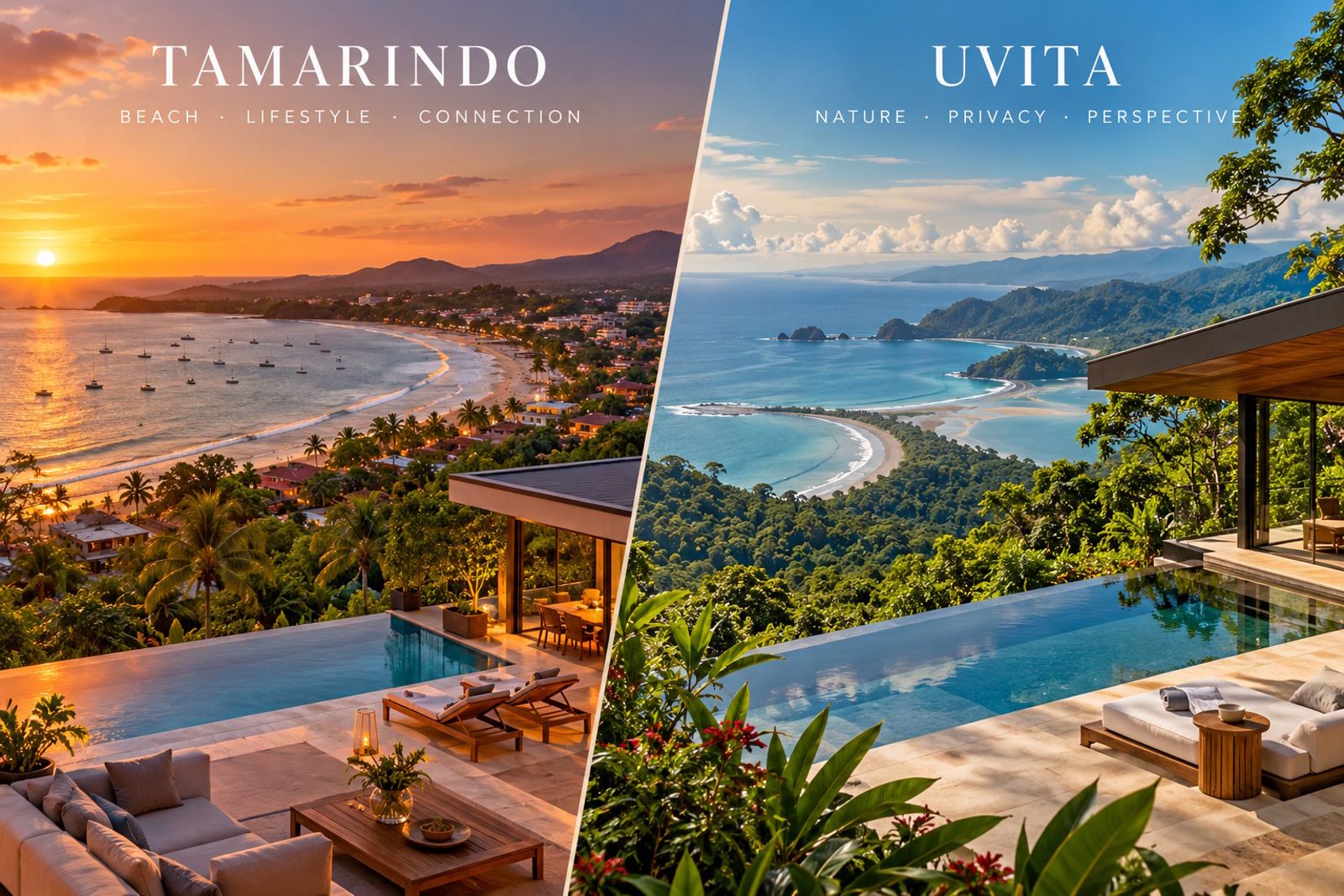
Tamarindo and Uvita are two places where that idea has taken hold, yet they represent strikingly different interpretations of life on Costa Rica’s Pacific coast. Tamarindo combines the ease of an established international beach destination with surfing, restaurants, services and a growing market for sophisticated homes and private residential communities. Uvita, several hours farther south, belongs to a more dramatic landscape of rainforest-covered hills, waterfalls and ocean views, where contemporary villas often seem designed around privacy and nature rather than proximity to town.
For a holiday, the difference is intriguing. For anyone imagining a home in Costa Rica, it becomes considerably more important.
Key Takeaways
Tamarindo offers an established, cosmopolitan version of Pacific life, with a strong surf culture, restaurants, international residents and a developed market for luxury homes and private communities. Uvita and the surrounding Costa Ballena feel greener, more secluded and more closely connected to the rainforest, attracting buyers drawn to privacy, larger plots and contemporary homes overlooking the Pacific.
Neither destination is simply a place to buy a beautiful house and remain behind its gates. Access to beaches, restaurants, nature, healthcare and the wider region matters, and a car can significantly expand the life available beyond the property itself.
For buyers considering a second home rather than a permanent move, Costa Rica also offers the possibility of spending extended periods in the country. Immigration and residency requirements change, however, and should always be checked against current official information when plans become concrete.
Tamarindo: An Established Pacific Lifestyle
Tamarindo has grown far beyond its origins as a laid-back surf town. The waves are still there, as are the barefoot mornings and long Pacific sunsets, but around them has developed one of Guanacaste’s most established international communities.
That evolution is precisely what makes Tamarindo interesting to someone considering more than a holiday. Restaurants, cafés, shops, fitness and wellness offerings and everyday services have become part of the town’s fabric, while the wider area has attracted increasingly sophisticated residential development. It is possible to live close to the energy of Tamarindo without necessarily living in the middle of it.
Projects such as Senderos illustrate how the market has evolved. Rather than treating the house as an isolated object, the development combines contemporary architecture and private homesites with proximity to Tamarindo’s beach and amenities. South of town, the much larger Hacienda Pinilla offers another interpretation of residential life, combining private communities with golf, equestrian facilities, a beach club, sporting amenities and access to the coast.
This makes Tamarindo particularly compelling for buyers who want their Costa Rican home to be part of an active life. The attraction is not simply returning to a beautiful villa at the end of the day; it is being able to leave it in the morning and have choices.
Surfing remains one of those choices. Tamarindo’s broad beach and established surf culture make the ocean part of everyday life, while a car opens up much more of Guanacaste’s coastline, from quieter beaches and beach clubs to restaurants and neighboring communities. For owners who divide their year between countries, that combination of tropical setting and established infrastructure can make arriving in Costa Rica feel relatively effortless.
Uvita and the Costa Ballena: Space, Privacy and the Rainforest
The transition to Uvita is not simply a change of town. The landscape itself begins to feel different.
Along the southern Pacific coast, dense vegetation descends from the mountains toward the ocean. Rivers and waterfalls cut through the forest, tropical gardens seem to grow almost faster than they can be tended, and Marino Ballena National Park protects one of the coast’s most recognizable landscapes. The famous Whale Tail, revealed by the tides, has become the area’s visual signature, while seasonal humpback whale migrations add another dimension to life beside the Pacific.
For the luxury residential market, this geography creates something Tamarindo cannot easily replicate: elevation, rainforest and extraordinary privacy within sight of the ocean.
Around Uvita and the wider Costa Ballena, high-end property is often less about belonging to a large resort environment and more about finding the right piece of landscape. Contemporary villas sit in the hills above the coast, opening toward ocean and mountain views and using terraces, pools and broad expanses of glass to dissolve the distinction between indoors and outdoors. Low-density communities such as Dulce Pacífico follow a similar philosophy, pairing serviced homesites and modern infrastructure with the privacy of a tropical hillside setting.
For a buyer whose idea of luxury is measured in space, silence and an uninterrupted horizon rather than proximity to a social scene, Uvita has an obvious appeal.
Yet living close to nature does not mean withdrawing from life. Uvita, Dominical and the communities of the Costa Ballena provide restaurants, markets and a growing international population, while the region itself supplies much of the entertainment. Beaches, waterfalls, national parks, whale watching and surfing can turn an ordinary week into something that still feels remarkably close to a holiday.
The difference is that here a car becomes particularly valuable. Many of the most desirable homes are chosen precisely because they sit above the coast or away from busier roads. Having your own transport makes it possible to enjoy that privacy without allowing it to become isolation, whether the destination is dinner in Uvita, a morning in Dominical, a hidden beach or simply the weekly shop.
Two Different Ideas of a Second Home
This is perhaps where the contrast between Tamarindo and Uvita becomes most interesting.
A second home is rarely only about the property. Architecture can seduce instantly, particularly when the swimming pool appears to disappear into the Pacific, but the surrounding life determines whether a place continues to work after the novelty has faded.
Tamarindo offers a more connected interpretation. A homeowner can move easily between private life and a lively international community, with the beach, restaurants, surfing and services forming part of the daily rhythm. The surrounding residential market reflects that demand, from individually designed villas to established private communities offering amenities that make part-time residence relatively straightforward.
Uvita offers a more retreat-oriented interpretation. Here, the house itself may become more intimately connected to the landscape, with rainforest, elevation and privacy playing a greater role in the decision. The reward is a home that can feel genuinely removed from the world without requiring its owner to abandon the pleasures of the coast.
Neither is inherently more luxurious. They simply define luxury differently.
For one buyer, it may mean being able to swim in the morning, meet friends for lunch and return home without planning the entire day around a car. For another, it may mean opening the doors at breakfast and seeing nothing between the terrace and the Pacific except forest.
That distinction is far more useful than comparing square meters or asking which destination offers the cheaper property.
Life Beyond the Villa
Anyone planning to spend several months a year in Costa Rica eventually discovers that the quality of a location is revealed by ordinary days as much as extraordinary ones.
Mobility is a good example. A spectacular hillside home can provide the privacy and view that made Costa Rica irresistible in the first place, but owners will still want to explore. Guanacaste and the Costa Ballena both reward having a car, although the reasons can differ. Around Tamarindo it broadens an already accessible lifestyle, opening up neighboring beaches, restaurants, golf and the wider peninsula. Around Uvita it becomes more integral to moving comfortably between a private home, the coast and the many natural attractions spread across the region.
The same principle applies to connectivity. Reliable internet is no longer merely a concern for backpacking digital nomads. Owners spending part of the year abroad may run businesses, manage investments, speak with family or simply expect a modern home to function digitally. In Costa Rica, that makes the infrastructure of the individual development and property worth examining rather than assuming that an ocean view and connectivity automatically arrive together.
Healthcare also becomes more relevant as stays become longer. Not because living in Costa Rica should be approached with anxiety, but because a second home is meant to make life easier. Knowing what medical facilities are available locally and how quickly more comprehensive private care can be reached is simply part of evaluating a location seriously.
These considerations are not the opposite of the dream. They are what allow the dream to work beyond the first few weeks.
Architecture Made for the Tropics
Costa Rica’s climate has also shaped some of its most interesting contemporary residential architecture.
A home designed for a tropical hillside has different priorities from an apartment in London, Munich or New York. Shade, airflow, drainage, materials and the relationship between interior and exterior spaces become part of the architecture rather than technical details hidden behind it.
This is particularly apparent around the wetter southern Pacific coast, where the abundance of rain is responsible for the extraordinary greenery that makes the region so desirable in the first place. Well-designed homes embrace that environment rather than attempting to seal it outside, using covered terraces, generous rooflines, cross-ventilation and indoor-outdoor living spaces that remain useful beyond the driest months of the year.
In Guanacaste, where the landscape and seasonal rhythm are different, architecture responds in its own way, often combining clean contemporary lines with shaded outdoor areas, pools and spaces designed around Pacific sunsets.
For buyers looking at newly built villas or developer projects, these details can be more revealing than an impressive kitchen or another bedroom. A successful Costa Rican home should not simply look tropical. It should understand the tropics.
From Holiday Destination to Part-Time Home
There is an important difference between moving permanently to Costa Rica and deciding to make it part of your life.
For many international buyers, the second option may be the more attractive one. A home on the Pacific coast can become somewhere to spend a winter, several months each year or longer periods when work and family allow, without requiring every connection to another country to be severed.
Costa Rica has various immigration and residency arrangements for visitors, remote workers, retirees, investors and other longer-term residents. The details and financial requirements can change, which is precisely why they are better treated as part of an individual legal plan than reduced to a number in a travel article. Anyone moving from the idea of an extended stay to a property purchase should check the rules currently in force and obtain appropriate professional advice where necessary.
The property itself deserves the same attention. Foreign ownership is well established in Costa Rica, but coastal zones, title, water availability, access and development permissions require proper due diligence. A sophisticated buyer would expect nothing less when purchasing elsewhere in the world, and a Pacific sunset is no reason to lower that standard.
What matters first is deciding which Costa Rica you actually want.
Tamarindo or Uvita?
For the traveler, both destinations deserve attention. For the potential homeowner, their differences become the attraction.
Tamarindo makes sense for someone drawn to a more established international beach lifestyle, where surfing, dining, social life and services remain close at hand and residential communities can provide an additional layer of convenience.
Uvita and the Costa Ballena speak to a different desire: more land, more privacy, a closer relationship with the rainforest and architecture that takes its cues from the landscape. Life can feel more secluded, but the reward is a sense of retreat that is increasingly difficult to find in the world’s better-known tropical destinations.
The most revealing way to choose between them may be to stop thinking like a tourist for a moment. Spend time in the neighborhood in which you might actually buy. Drive from the house to the beach, to dinner and to the places you would use in everyday life. See the property in rain as well as sunshine. Sit on the terrace when there is nowhere you need to be.
Because the real question is no longer whether Tamarindo or Uvita makes the better Costa Rican holiday.
It is what you would like your life in Costa Rica to look like once you have your own front door.
FAQ
What is the main difference between Tamarindo and Uvita?
Tamarindo offers a more established international beach-town lifestyle with surfing, restaurants, services and residential communities close at hand. Uvita and the Costa Ballena are more closely defined by rainforest, privacy, ocean-view hillside properties and access to nature.
Are there luxury homes and residential developments in both areas?
Yes, although the character of the markets differs. The Tamarindo area includes established private communities and contemporary residential developments, while the Uvita and Costa Ballena market features many individually designed luxury villas, larger tropical properties and lower-density hillside communities.
Is a car useful if you own a home in Costa Rica?
For many second-home owners, yes. Even where restaurants and beaches are nearby, a car makes it considerably easier to explore the surrounding coastline and use a property as a base for a wider Costa Rican lifestyle. It becomes particularly useful for homes in elevated or more secluded locations.
Which destination offers more privacy?
The hills around Uvita and the Costa Ballena are particularly attractive to buyers seeking larger properties, rainforest surroundings and separation from busier tourist areas. Tamarindo also offers private and gated residential options, but within a more developed and socially active destination.
Can foreigners buy property in Costa Rica?
Foreign buyers participate actively in Costa Rica’s property market, but the legal structure of a property matters, particularly in coastal areas. Independent due diligence on title, access, water and applicable development or concession rules is important before purchasing.
Can a second-home owner spend several months a year in Costa Rica?
Many international owners do spend extended periods in Costa Rica, but the immigration status appropriate to a particular stay depends on individual circumstances. Because entry and residency requirements can change, current official information should be checked when planning longer or recurring stays.