Living abroad changes more than your address. Sometimes, it redraws the map of the world around you.
There is a curious moment that comes with living abroad. It rarely happens on moving day, and almost never while you are still unpacking boxes or learning where to buy decent bread. It comes later, when the unfamiliar has begun to feel ordinary and you suddenly realize that your mental map of the world has changed.
Places that once seemed impossibly distant are no longer quite so far away. A destination that required months of planning from Europe or North America may now sit on the other side of your region. Countries once filed away under perhaps someday begin to look surprisingly possible.
It is one of the less discussed privileges of building a life abroad. You do not simply gain a new home. You gain a new neighborhood – and sometimes that neighborhood is enormous.
For those living in the Asia-Pacific region, one of its more extraordinary corners is Papua New Guinea. And this September, high in the Eastern Highlands, there is an unusually compelling reason to look in its direction.
From September 18 to 20, 2026, the town of Goroka will host the 70th anniversary of the Goroka Show, one of Papua New Guinea’s longest-running and most important cultural gatherings. More than 100 cultural groups are expected to come together in an extraordinary concentration of music, dance, ceremonial dress and traditions that have little equivalent elsewhere in the world.
But describing the Goroka Show merely as a festival rather misses the point.
A Country That Defies Easy Description
Papua New Guinea is not a place easily reduced to a handful of cultural shorthand. Its extraordinary diversity is part of what makes the country so difficult to imagine from afar.
Across its mountains, valleys, islands and coastal regions, communities have developed distinct languages, customs, forms of dress, music and social traditions. Geography played its part. Mountain ranges and dense terrain kept communities separated for generations, allowing remarkably localized cultures to endure.
This is important to understanding Goroka.
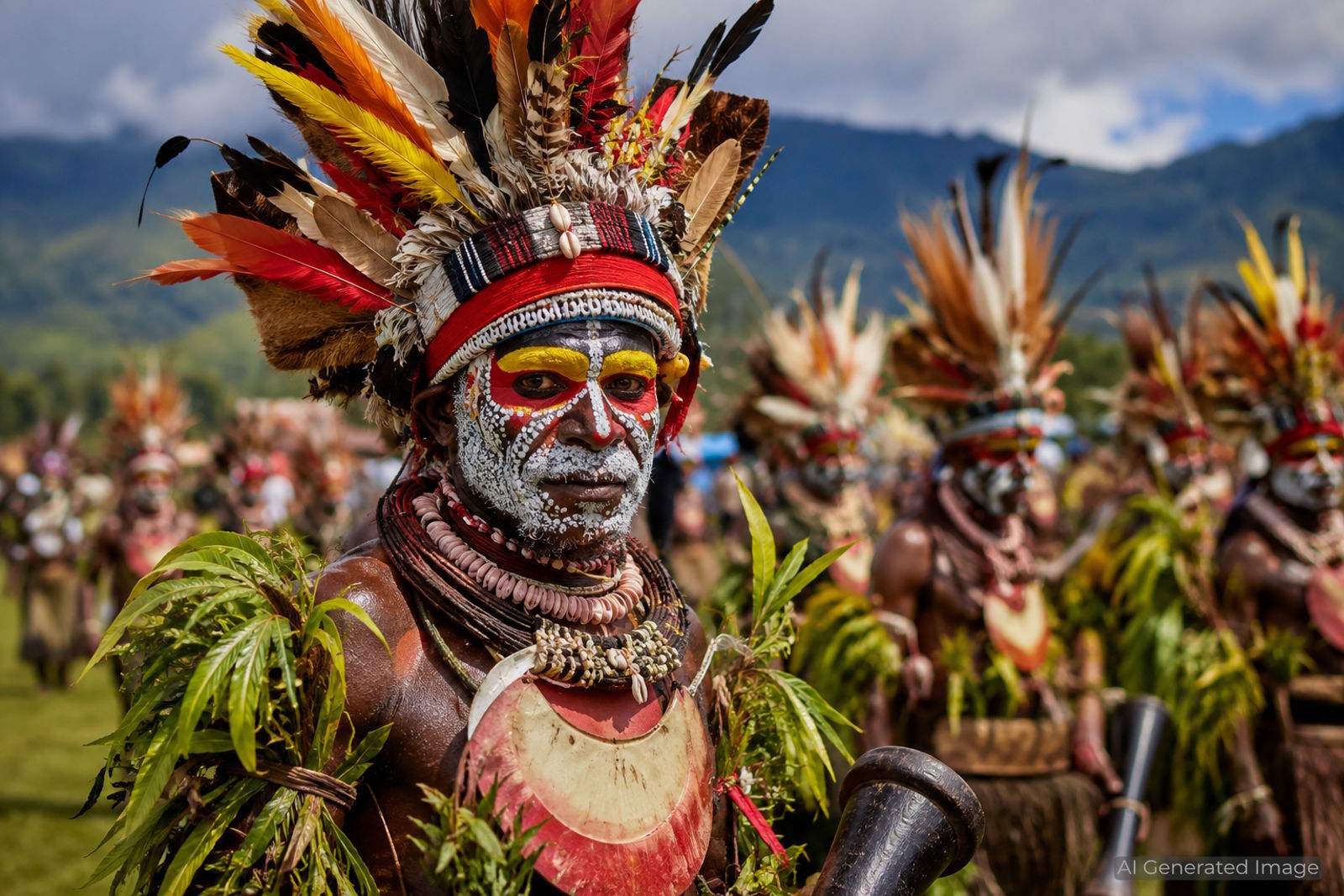
When groups arrive at the showgrounds in elaborate headdresses, body paint, shells, feathers and traditional adornments, they are not collectively performing some generic version of “Papua New Guinean culture.” Quite the opposite. Much of the fascination lies in the differences.
A headdress can speak of place and community. A pattern of body decoration can be recognizable to those who understand its context. Songs and dances carry stories, memory and identity. What appears from the grandstand as an explosion of color becomes, on closer inspection, a gathering of individual cultures.
For a visitor, it is difficult to absorb all of this at once. Perhaps that is precisely why Goroka has remained so compelling.
The Sing-Sing: Much More Than a Performance
At the center of the Goroka Show are the sing-sings – a term from Tok Pisin, the country’s widely spoken lingua franca. The phrase sounds almost disarmingly simple, but what unfolds is anything but.
Drums establish rhythms that can be felt before their source is visible. Voices rise collectively. Groups move in patterns practiced and inherited across generations. Feathers shift above intricately decorated faces; shells, leaves and other natural materials become part of elaborate bilas – the Tok Pisin word for the ceremonial body adornments worn to express identity, status, and heritage during cultural gatherings.
To an outsider arriving with a camera, the visual spectacle can be overwhelming. Yet treating the sing-sing purely as spectacle strips away much of what makes it interesting.
These are expressions of belonging.
They connect generations and communities, and they offer a way for cultural knowledge to remain visible in a country that, like almost everywhere else, is negotiating the pressures of modernization. Contemporary Papua New Guinea and traditional Papua New Guinea do not exist in separate worlds. At Goroka, they stand remarkably close together.
That distinction matters. The people gathering here are not museum exhibits preserving a frozen version of the past. They live in the present, while choosing to carry elements of their cultural identity with them.
And that makes the Goroka Show far more interesting than any staged reconstruction could ever be.
Seventy Years of Coming Together
The origins of the show add another layer to its significance.
The first official Goroka Show was held in 1957, during the Australian colonial administration, when patrol officers known as kiaps helped organize a gathering intended to bring communities of the Eastern Highlands together through cultural performances and sing-sings.
In a region where relationships between neighboring groups had not always been peaceful, gathering on common ground had a purpose beyond entertainment.
Over the decades, the event evolved. Papua New Guinea became independent in 1975. Goroka grew. Generations changed. Yet the gathering survived.
In 2026, it marks 70 years.
Today, the show is held around Papua New Guinea’s Independence celebrations and has become an expression not only of individual cultural identities but of a country attempting to celebrate the remarkable diversity contained within its borders.
That history makes the scene particularly intriguing. Unity here does not mean everybody becoming alike. It means bringing difference into the same space.
There may be few better illustrations of Papua New Guinea itself.
Beyond the Feathers and Face Paint
The photographs inevitably concentrate on the spectacular. They should. The visual language of Goroka is extraordinary.
Some participants appear beneath immense constructions of feathers. Faces may be painted in brilliant pigments; bodies decorated with natural materials, shells and ornaments. Kundu drums accompany dancers.
Among the best-known figures associated with the region are the Asaro Mudmen. According to local folklore, these warriors once covered themselves in gray mud and wore haunting, oversized clay masks to defeat a rival group – not through force, but by convincing their enemies they were spirits returning from the ancestral realm. Today, their eerie, silent movements amidst the vibrant sea of dancers remain one of the most striking sights at Goroka.
But photographs have their limitations.
They capture the instant when somebody looks most extraordinary and leave out the hours surrounding it: preparation, conversation, waiting, families gathering, performers adjusting their adornments and people meeting others who may have traveled considerable distances to be there.
This is where a visitor has a choice.
It is possible to attend Goroka, collect hundreds of spectacular photographs and leave having seen very little. Or it is possible to become curious about what lies behind them.
Who are the people in front of the lens? Where have they come from? What does a particular decoration signify? Is a song ceremonial, historical, celebratory? Which traditions remain part of everyday community life, and which emerge particularly for occasions such as this?
The difference between looking and understanding is often no more complicated than remembering to ask.
Travel as a Guest, Not a Collector
Cultural events of this kind also raise a question that increasingly accompanies travel to places whose traditions have become attractions in their own right: how do we look without turning people into exhibits?
There is no universal rule book capable of solving that tension. Tourism brings money, attention and opportunity; it can also encourage simplification, intrusion and a relentless appetite for the perfect photograph.
A little restraint therefore goes a long way.
Permission before a close portrait is more than etiquette. So is accepting that not every ceremony, person or moment exists for the visitor’s camera. Taking time to step back, observing the rhythm of the day, and engaging with performers before raising a lens allows for far more meaningful, respectful encounters.
Spending money with local guides, craftspeople and businesses can make a visit more meaningful to the community hosting it. Learning even a small amount about the people one is photographing changes the nature of the encounter.
Perhaps most importantly, Goroka deserves the same curiosity we would bring to any complex culture closer to home.
The goal is not to romanticize Papua New Guinea as some untouched corner of the planet. It isn’t. Nor is the value of the Goroka Show that it allows outsiders to step backwards in time. Its value lies precisely in the opposite: these traditions are here, now.
Goroka Beyond the Showgrounds
The setting makes the experience stranger still for anyone whose image of Papua New Guinea begins with tropical islands.
Goroka lies in the Eastern Highlands, surrounded by mountains and agricultural land, at roughly 1,600 meters above sea level. The altitude brings a climate far removed from the steamy tropical stereotype. Mornings can feel cool; mist hangs over green slopes; coffee grows in the surrounding highlands.
The town is an important center for the region, but nobody would mistake it for a polished international resort destination. That is part of the point.
A journey here requires more thought than a spontaneous weekend in Bali or Singapore. Papua New Guinea is a destination where local knowledge matters, logistics deserve attention and assumptions imported from more heavily touristed parts of Asia-Pacific are not particularly useful.
For the Goroka Show in particular, planning early makes sense. Major cultural festivals fall within Papua New Guinea’s May-to-October peak travel period, and the country’s tourism authority recommends advance arrangements for popular events.
This is not a destination to approach casually. It is, however, exactly the sort of place that reminds us why curiosity should occasionally win over convenience.
When Far Away Becomes Surprisingly Close
And this brings us back to living abroad.
When people imagine relocating internationally, they understandably focus on what they will gain and lose in everyday life. Housing. Healthcare. Climate. Food. Friends. Language. Taxes. Familiarity.
All of those things matter.
What is discussed much less often is the geographical shift.
Move your life from London to Singapore and the distances between you and the rest of the world rearrange themselves. Settle in Kuala Lumpur and destinations that once belonged to an entirely different journey move onto your regional map. Build a second life in Australia and the Pacific stops being an abstraction on the far side of an atlas.
Not every nearby country needs to become somewhere you might live. That would be to miss the pleasure of it. Some places can simply become somewhere you now have the extraordinary possibility to encounter.
Papua New Guinea may never appear on most people’s shortlist for a second home or a new permanent address. It does not need to. The point is that choosing a life abroad can place you closer to worlds you might otherwise never have considered at all.
For three days this September – from September 18 to 20, 2026, at the National Sports Institute Field Grounds in Goroka – more than 100 cultural groups will gather in a highland town many people outside the region would struggle to place on a map. Domestic flights connect through Port Moresby, and with the show less than a month away, anyone considering the 2026 event should check flight and accommodation availability before making further plans.
Perhaps that is reason enough to place it on yours.
Arrive curious. Because one of the great rewards of living abroad is not simply learning to understand the place you chose. It is discovering how much larger your new neighborhood has become.